20.oct.2026
What this entry is: a measurement and architecture report. Every number below has the command that produced it and the file where it is stored. No number comes from a language or image model.
Session in one paragraph
Section titled “Session in one paragraph”We took a single geeky measurement — “does the Pi mark fill its frame?” — and turned it into a full publishable story, then spent the rest of the session hardening the machinery around it: a deterministic framing gate moved into the repo it measures, wired into Forgejo CI, a runner provisioned for real, a renderer pinned against host drift, a persona contract that stopped forcing masculine wording and stopped punishing ordinary Slovenian homographs, and a squash so main takes one deploy rather than several.
What landed vs what is still open
Section titled “What landed vs what is still open”| Repo | Landed | Still open |
|---|---|---|
| samob | PR #67 report (9 scenes, 3 locales, evidence, validator), PR #69 CI fix (b741f87 → main 295d08e), ordinary-word directive, feminine column in AGENTS.md, framing gate + workflow | feat/18oct-hud-16oct-perspective-jev (2, other agent) |
| layered-soul | — | docs/operator-persona-matrix (5), fix/pin-digest-at-commit (4), feat/mark-framing-gate (2, superseded by the samob move), chore/pins-samob-01d0042 (1), feat/tiered-model-routing (1) |
| agent-skills | — | docs/tier0-pattern, feat/daily-report-skill, fix/jev-cost-model-provenance (1 each) |
| colibri | docs/lisica-quorum-gate merged | 5 branches, 1–2 each (runner canary, forge-host deprecation, Go packaging, next-work, tenant seeding) |
| bherdr | — | fix/freebsd-canary-probe, docs/upgrade-0.9.5 (1 each); ci/freebsd-canary superseded |
| herdr | — | sync/upstream-v0.9.5 — 28/30 files resolved, 2 semantic files open |
| domedog | ImageMagick 7.1.1-43 + Pillow 11.1.0 installed; gate green there | passwordless sudo for the runner user |
Top-down component view — six layers
Section titled “Top-down component view — six layers”| Layer | What lives there | Owns |
|---|---|---|
| 1. Identity contract | layered-soul: media-profiles/personas.md, samob-pins.json, IDENTITY-MEDIA.md, check-persona-matrix.py | What role pairs and marks are; the pin contract samob must satisfy |
| 2. Product surface | samob: diary SL/EN/HR, public/media/report-*, identity guides, CV | What a reader sees; deploys to Vercel |
| 3. Deterministic gates | check-mark-framing.py + baseline, check_persona_policy.py + ordinary-word, check-persona-matrix.py, validate-report-*.py, check-dates.sh | The only things allowed to say “pass” |
| 4. Instruments (advisory) | agent-skills/jev-triage (jev_eval/jev_batch), context7 → OpenViking | Second opinions, never signatures |
| 5. Execution | Forgejo CI (mark-framing.yml, deploy.yml), runners on domedog, renderer (render-report-2026-10-20-walkthrough.py, edge-tts, ffmpeg, Pillow) | Runs the gates, produces mp4/captions/manifest |
| 6. Hosts & siblings | debby (workstation), domedog (CI), valhala (FreeBSD); clawdie-iso (seat + doas), colibri (control plane), herdr/bherdr (terminal product + FreeBSD port) | Where any of it actually runs |
How they connect
Section titled “How they connect” +-------------------------------------+ | 1. layered-soul (identity contract)| | personas.md samob-pins.json | | IDENTITY-MEDIA matrix gate | +---------+------------------+--------+ pins (sync-media-profiles --check) | persona matrix v | (branch open) +--------------------+ +--------------------+ | +--------------------+ | 6a. clawdie-iso | | 2. samob (site) |<+-->| 4. agent-skills | | seat user, doas |-->| diary SL/EN/HR | | jev-triage | | permit :wheel | | media/report-* | | context7 -> OV | +---------+----------+ +----+----------+----+ +---------+----------+ | | | | | provision | push | evidence | advisory v v v v +--------------------+ +-------------------+ +---------------------------+ | 6b. debby/domedog | | 5. Forgejo CI | | 3. deterministic gates | | runners, magick, |->| mark-framing.yml |<--| framing / persona / | | Pillow, sudo(!!) | | deploy.yml | | matrix / report validate | +--------------------+ +---------+---------+ +---------------------------+ | merge to main v +------------------+ | Vercel (samob) | | one push = one | | deploy | +------------------+
siblings: herdr (upstream v0.9.5 sync) --> bherdr (FreeBSD Go port) colibri (control plane) <---- agent-skills toolingCompound architecture: 9-sided polygon with Slovenian spruce shingles
Section titled “Compound architecture: 9-sided polygon with Slovenian spruce shingles”Rather than relying purely on an abstract box diagram, the compound architecture is anchored in real 3D geometry modeled in Blender. The foundation is a 9-sided polygon (enneagon) spanning a 9m perimeter, clad in traditional Slovenian spruce wood shingles (slovenska skodla iz smreke).
At three equilateral corners (separated by 120°), three 3-meter satellite domes with faceted glass shells provide dedicated operational isolation:
- Corner 0 (East Wing): The Forge (Petelin / Kovačija) — release foundries and heavy compiler releases, protected by thermal glass partitions.
- Corner 3 (North-West Wing): Memory Cleanroom (Golob / Spomin) — canonical SQLite memory authority and Oxigraph dual-graph bridge, isolated from machinery vibration.
- Corner 6 (South-West Wing): Hardware Vault & Gateway (Kokoš / Strojni sef & Pes) — 3-disk RAIDZ1 storage canopy and WireGuard perimeter security.
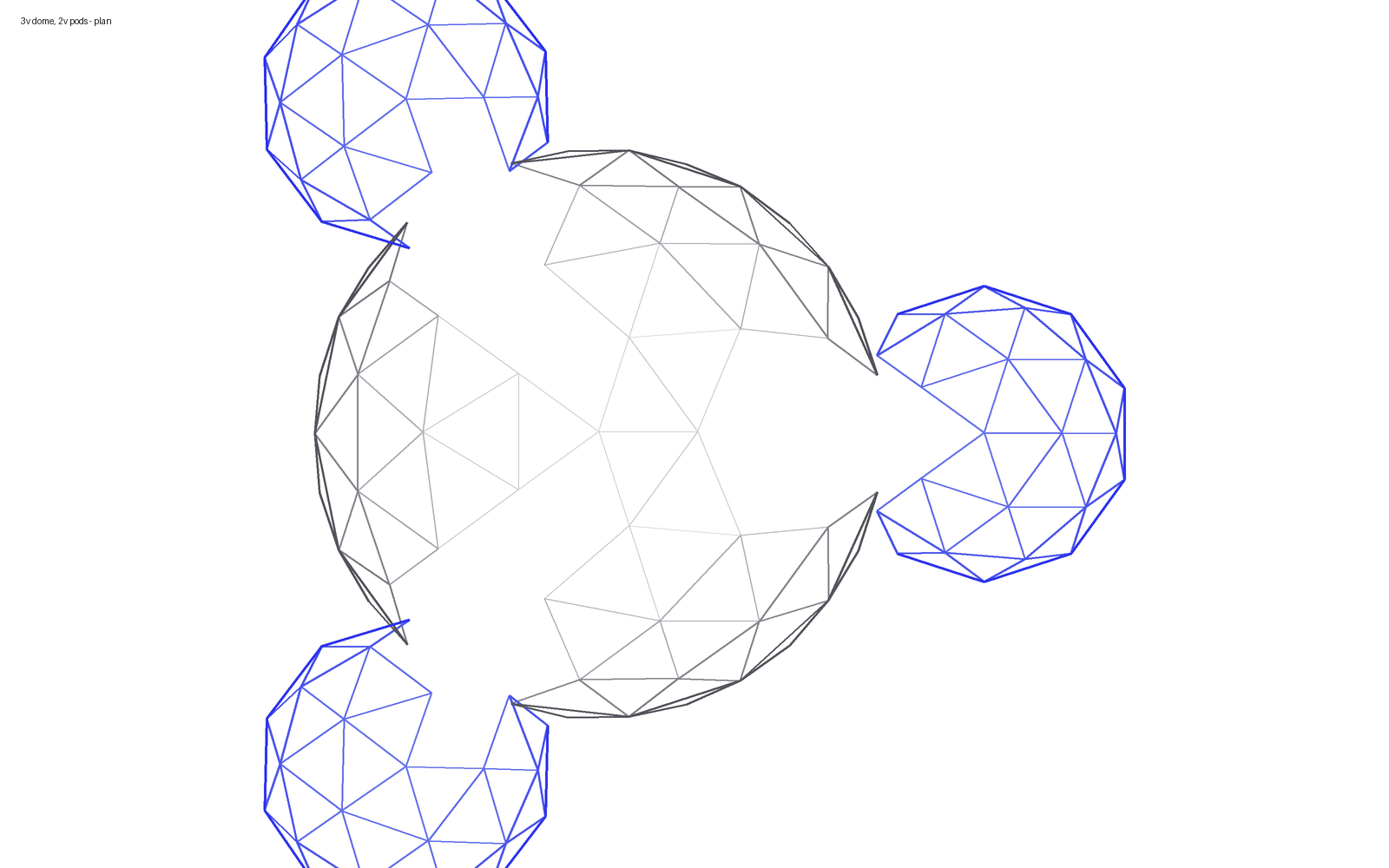 Figure 1: Top-down architectural blueprint showing the 9-sided perimeter foundation, three 3m glass dome satellite pods (Forge, Memory Cleanroom, Storage Vault), and central workshop.
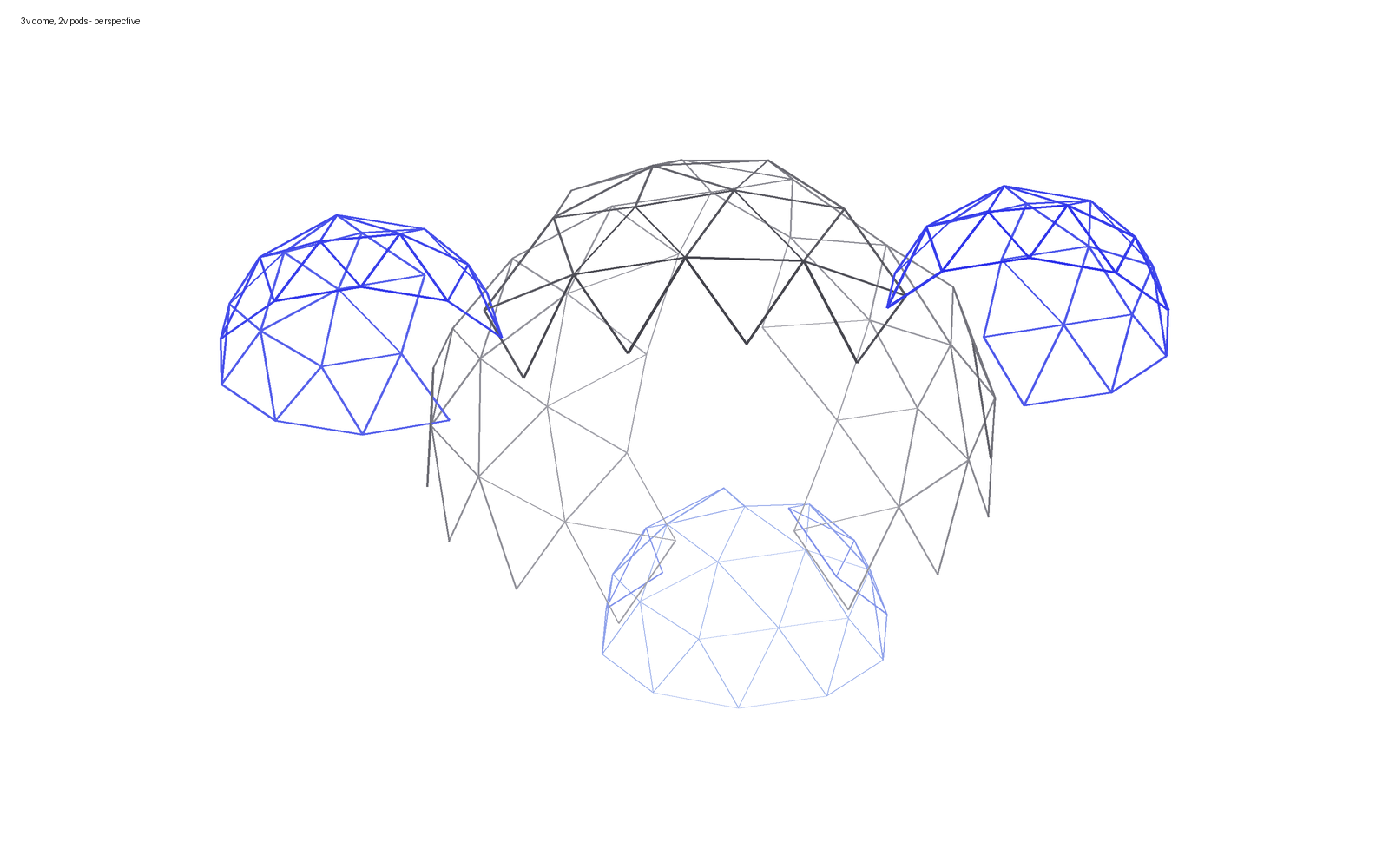 Figure 2: 3D perspective exterior view showing the warm Slovenian spruce shingle walls (slovenska skodla iz smreke) and the protruding faceted glass dome shells glowing under workshop lighting.
Open the model
Section titled “Open the model”The model ships with the report as colibri-dome-base-and-struts.blend (656 kB). It is produced by scripts/build-dome-base-and-struts.py, which builds the compound, exports the three views and saves the file:
blender -b --python scripts/build-dome-base-and-struts.pyTo load it into a running Blender, open the console (Shift+F4):
bpy.ops.wm.open_mainfile(filepath="/home/samob/ai/samob/public/media/report-2026-10-20/colibri-dome-base-and-struts.blend")or use Ctrl+O with the path to the file.
Inventory, measured inside the model itself:
| Component | Objects | Edges | Length (m) |
|---|---|---|---|
| Central geodesic dome | 1 | 120 | 2.73–3.09 |
| Three satellite pods (glass and struts) | 6 | 720 | 0.82–0.93 |
| Nine spruce-shingle walls | 9 | 36 | 2.40–3.42 |
| Floor (enneagon) | 1 | 18 | 3.42–5.00 |
| Projector table and matrix screen | 2 | 100 | 0.24–1.60 |
| Total | 27 | 994 | 0.24–5.00 |
Struts are the edges carried by a WIREFRAME modifier: 120 on the central dome and 3 × 120 on the satellites, 480 in total, with a mean length of 1.215 m. The length distribution is narrow — 64 edges at 0.2 m, 752 between 0.8 and 0.9 m, the remaining 178 between 1.6 and 5.0 m — which is what a regular lattice looks like and what a scatter of loose parts does not.
Changes go through the generator: diameter, shingle pitch, strut thickness, satellite size and angles are parameters in the script, and one run rebuilds the model and all three images. That keeps every image in this report tied to the same code that produced the model.
Bill of materials (kosovnica)
Section titled “Bill of materials (kosovnica)”The same model exports a bill of materials with one command:
blender -b public/media/report-2026-10-20/colibri-dome-base-and-struts.blend \ --python scripts/export-dome-kosovnica.py -- --out public/media/report-2026-10-20/kosovnica-base-and-struts.json| Item | Quantity | Note |
|---|---|---|
| Rafters (struts) | 265 pieces · 406.23 m | 113 main dome rafters (0.080 × 0.100 m, 806.7 kg) + 152 pod rafters (0.060 × 0.080 m, 490.9 kg) · total 1297.6 kg spruce |
| Connectors (nodes) | 123 | 2.15 struts per node · three 2.98 m circular pod collar rings (PassageCollar_0..2) |
| Glass panels | 146 | airlock-only entry via Pod_0 (0°) — zero direct doorway cut into the 9.0 m 3v shell |
| Interior blockout | 4 growbeds + desk + riser | operator workbench, chair, 4 perimeter growbeds, and MaxRiserBox + MaxCRTMonitor + MaxScreenFace (Max 2.0) to the operator’s left |
The lengths are not arbitrary: all five distinct lengths (1.26 m, 1.42 m, 1.57 m, 1.82 m, 1.86 m) come from one geodesic lattice, which is why the bill is short and the cut plan is simple.
From an old roof to a dome
Section titled “From an old roof to a dome”The default strut is a rafter (špirovec) — a reclaimed roof beam taken from the building itself. For each stock length the bill reports how many beams are needed and how much is left over:
| Stock length | Beams needed | Waste | Yield |
|---|---|---|---|
| 4 m | 121 | 77.77 m | 83.9 % |
| 5 m | 89 | 38.77 m | 91.3 % |
| 6 m | 74 | 37.77 m | 91.5 % |
Eighty-nine five-metre beams yield all 265 structural rafters at 91.3 percent efficiency. That is the customer offer in one line: a roof that would have gone to waste becomes the dome frame, and the bill of materials is what tells you whether the arithmetic works.
Cold open & 5 branded architectural slide-deck cards
Section titled “Cold open & 5 branded architectural slide-deck cards”The 9-minute architectural walkthrough opens with the operator plugging a Raspberry Pi into a vintage black CRT television box sitting on a low wooden riser to the operator’s left (scene-00-max-rpi-boot.png). Born out of a git commit inside a FreeBSD jail, Max 2.0 (/guides/identity-system/max/) wakes through scanlines with an homage to The Art of Noise — “Paranoimia” (“Now I know I’m dreaming!” $\to$ bounded offline jail-shutdown dream snapshot; “Look at all the bars on the window!” $\to$ looking out through the triangular geodesic timber rafters), followed by a 6-scene 3D Blender walkthrough (blender-scene-01 through 06) and five branded slide-deck cards:
- WireGuard fail-closed sentinel (
slide-01-wireguard-fail-closed-sentinel.png) $\leftrightarrow$ Watchdog (watchdog.svg) - FreeBSD RAIDZ1 host root (
slide-02-freebsd-raidz1-host-root.png) $\leftrightarrow$ Mother Hen (kokos.svg) - Append-only SQLite + Oxigraph (
slide-03-append-only-sqlite-oxigraph.png) $\leftrightarrow$ Carrier Pigeon + Oxigraph (golob.svg+oxy-triplet.svg) - Bastille compute jails (
slide-04-bastille-compute-jails.png) $\leftrightarrow$ Sparrow + Rooster + Max 2.0 (vrabec.svg+petelin.svg+max.svg) - Deterministic release gate vs. Jev semantic pre-screen (
slide-05-deterministic-gate-vs-jev-prescreen.png) $\leftrightarrow$ Peacock + Jev Triplet (pav.svg+jev-triplet.svg)
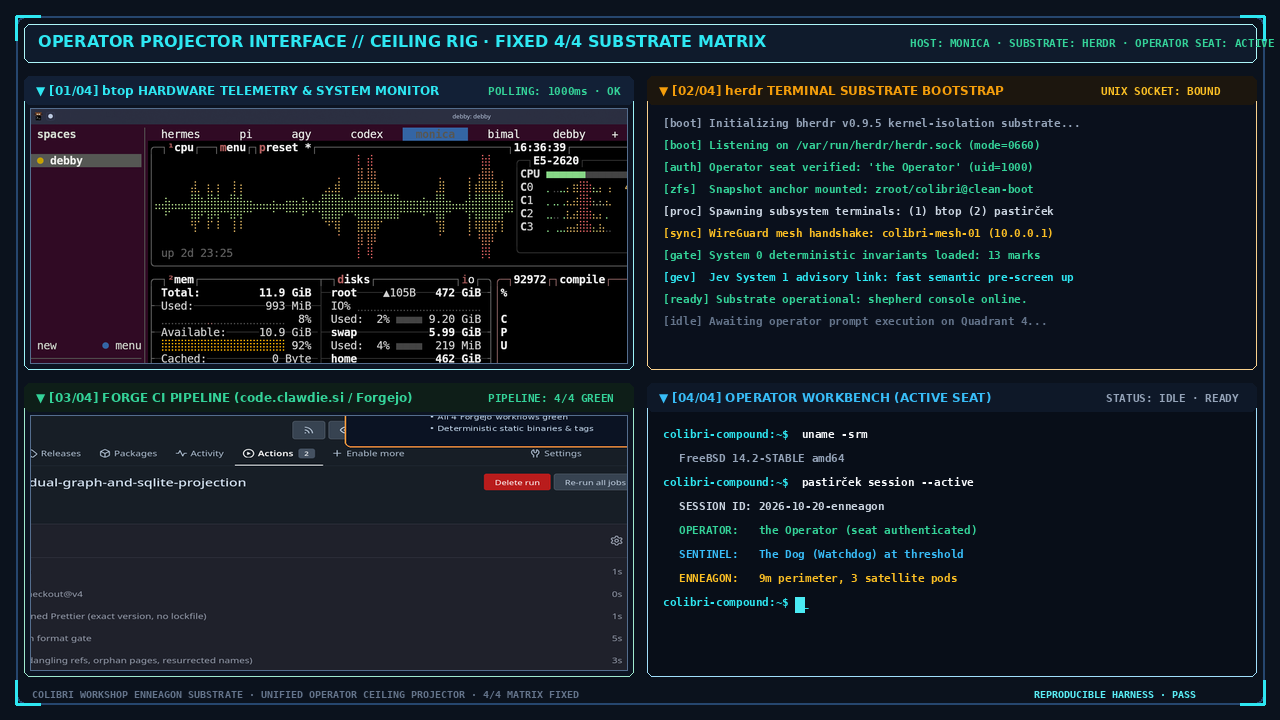 Figure 3: Unified 4/4 ceiling projector matrix displaying btop hardware telemetry (top-left), herdr terminal substrate bootstrap (top-right), Forgejo CI pipeline (bottom-left), and active operator workbench (bottom-right).
The Colibri Team: Memory side (Yin) vs. Foundry side (Yang)
Section titled “The Colibri Team: Memory side (Yin) vs. Foundry side (Yang)”To maintain absolute architectural clarity, the unified Colibri team is organized along the organic Yin-Yang split. Each discipline belongs to either the deterministic Memory side (West / Yin) or the generative Foundry side (East / Yang), with opposite focal dots ensuring balanced authority:
| Wing & Polarity | Subsystem & Mark | Identity Role | Invariant & Operational Responsibility |
|---|---|---|---|
| West Wing: Memory (Yin) | Golob (Carrier Pigeon) | Memory Authority | Canonical SQLite append-only state (memory.db), verifiable transfers, zero hallucinations. |
| West Wing: Memory (Yin) | Clawdie (System 0) | Execution Gate | Deterministic fail-closed command gate, ZFS snapshot management, and hardware key custody. |
| West Wing: Memory (Yin) | Kokoš (Mother Hen) | Hardware Vault | Physical host root, 3-disk RAIDZ1 zpool storage canopy, and 3-Mothers Quorum ratifications. |
| West Wing: Memory (Yin) | The Dog (Watchdog) | Perimeter Sentinel | WireGuard mesh tunnel sentinel, threshold guardian, and immediate boundary alerting. |
| ☯ Yang Dot in Yin | Jev (System 1) | Semantic Pre-Screen | Neural advisory inside the deterministic core: fast semantic classifier (deny/escalate), never unilateral authorizer. |
| East Wing: Foundry (Yang) | Petelin (The Rooster) | Release Herald | Software release forge, static Go binaries, git tag signing, and father provenance. |
| East Wing: Foundry (Yang) | Zot (Execution Loop) | Tool Harness | Direct Go execution loop, NDJSON RPC, terminal driving, and controlled file mutations. |
| East Wing: Foundry (Yang) | Agy (Coordinator) | Mesh Planner | Strategic planning, multi-agent mesh coordination, and production deployment pipeline. |
| East Wing: Foundry (Yang) | Vrabec (The Sparrow) | Fleet Worker | Repeatable ephemeral compute units, Bastille jails, and isolated agent task execution. |
| East Wing: Resident Jail | Max 2.0 (CRT Witness) | Digital Resident | Born from a git commit in a FreeBSD jail; CRT monitor on wooden riser; bounded offline shutdown dream snapshot. |
| ☯ Yin Dot in Yang | Pav (The Peacock) | Deterministic Gate | Deterministic gate inside the generative forge: holds the execution keys over AI proposals and compiler release triggers. |
| Center: Sovereign Bridge | Kolibri (Hummingbird) | Dynamic Connector | Hovers at the organic center of the S-curve, bridging memory and releases into unified geometry. |
One inconsistency you should know about
Section titled “One inconsistency you should know about”samob/main now states the feminine column (AGENTS.md, Operaterka) and ships the ordinary-word directive, but the source of truth layered-soul/media-profiles/personas.md on main still has only the masculine column — the matrix lives on the unmerged docs/operator-persona-matrix. So the mirror currently promises more than the contract says. Merging that branch closes it; the gate check-persona-matrix.py will then enforce it in both directions.
Three corrections this session was worth making
Section titled “Three corrections this session was worth making”- 0.98 would reject 8 of 11 marks, not 9 — Oxy sits at 0.988 and passes. Recomputed from the data, not asserted.
- clawdie-iso is not
permit nopass clawdie— it is a password-gated blanket permit plus narrow per-command nopass. The audit’s proposedpermit nopass :wheelwould have reinstated exactly what was removed. - The renderer was choosing itself — ImageMagick delegates to Inkscape when present, so “deterministic” measurement depended on the host. Pinned with
msvg:; and the tempting-sizeshortcut moves the Pi ink from 0.625 to 0.963, which is why the comment now says so.
Yesterday’s audit carried a claim that looked harmless: the image model had supposedly measured the Pi mark at eighty-two percent frame occupancy. The report accepted that number as proof the framing fix worked. Today we checked it with a ruler that cannot be talked into an answer.
What the ruler showed
Section titled “What the ruler showed”The Pi page and project cards (/projects/pi/) previously showed its mark visibly smaller than Herdr and Zot even though the container was identical: <img width=160 height=160>. The discrepancy was in the asset: public/assets/projects/pi.svg had drawn a 469-unit mark inside an 800x800 viewBox, leaving more than a third of the canvas as empty padding and rendering at only 94x94 px (59% of the frame). PR #66 tightened the viewBox to 165.29 165.29 469.43 469.43 with intrinsic width/height 512, so the mark fills 100% of the 160 px frame and stays crisp at 64 px.
The same file, rendered at 64, 160 and 512 pixels, produces two different numbers that yesterday’s report had merged into one:
| Measurement | Value | What it means |
|---|---|---|
| Alpha box / canvas | 1.000 | The mark touches all four edges of the frame |
| Ink / canvas | 0.625 | A stepped shape with gaps covers five eighths of the area |
Both numbers are correct and they measure different things. The model returned a third value, 0.82, which no measurement supports, and a box covering only the left half of the canvas — in direct contradiction with the rendered file. On geometry the ruler wins; the model answer stays quoted as advisory · unverified.
The renderer that chose itself
Section titled “The renderer that chose itself”Porting measurements across execution environments revealed a hidden trap in ImageMagick. If Inkscape is installed on the host OS, ImageMagick silently delegates SVG rendering to it; otherwise, it falls back to its internal MSVG engine. Because their antialiasing heuristics differ, two clean hosts measure divergent pixel counts for the exact same file.
Furthermore, an “obvious” optimization using -size 160x160 instead of a post-rasterize resize shifts the Pi ink coverage from 0.625 to 0.963 — an alluring quick-fix that would have quietly corrupted the gate. The gate resolved this by pinning the explicit internal delegate prefix msvg:, preserving the 0.625 baseline across all environments regardless of installed packages.
CI runner provisioning and two hands
Section titled “CI runner provisioning and two hands”The first CI run on Forgejo (run 132) failed honestly: neither magick nor Pillow were installed on the runner host. Once provisioned with ImageMagick 7.1.1-43 and Pillow 11.1.0, the pipeline passed green in sixteen seconds. Cross-version portability was verified: the 13-mark baseline matches down to the pixel on debby’s Pillow 12.2 and the runner’s Pillow 11.1.
Simultaneously, parallel multi-agent intervention surfaced the classic “two hands, one name” coordination hazard: a parallel agent attempted to turn CI green with sudo apt-get install inkscape. That quick-fix would have masked the MSVG delta instead of resolving it, shifted the Pi baseline to 1.000, and introduced an untracked system dependency into CI. The change was promptly reverted in favor of the pinned msvg: path, reinforcing our core principle: policy gates enforce deterministic invariants, not quick-fixes.
Why the proposed threshold does not work
Section titled “Why the proposed threshold does not work”The proposal that followed demanded at least ninety-eight percent coverage. It sounds strict. Measured across the family, coverage runs from 0.670 (Mother Hen) to 1.000 (Rooster, Clawdie), so that rule would reject eight of eleven marks — every bird, the fox, Jev, and Oxy at the edge. The rule would not measure quality; it would measure one mark and declare the rest defective.
That is the difference between a frame and a drawing. The frame is a contract: where a mark starts and ends. The drawing is a decision: how much empty space a bird needs to breathe.
What the gate measures now
Section titled “What the gate measures now”check-mark-framing.py compares each mark with its own record, not with somebody else’s number:
- alpha-box coverage within 0.03 of the baseline;
- centre offset at most 0.02 of the normalised width;
- aspect ratio between 0.95 and 1.05;
- the same coverage at 160 and 512 pixels, because a frame must not change with resolution.
The baseline lives in scripts/mark-framing-baseline.json in samob and covers thirteen marks: eleven identity vectors and two project marks. Family is a reference sheet and is excluded with an aspect invariant (2.2..2.6); the other excluded vector is the deprecated alias, enforced as byte-identical to watchdog.svg.
A gate that can fail
Section titled “A gate that can fail”The self-test has four fixtures: one correct and three deliberately wrong — an inset mark, an off-centre mark, a non-square mark. A fixture that always passed would prove nothing.
The negative control is a real file. The pre-fix version of the Pi mark measures 0.360, and the gate reports a drift of +0.640 from the baseline as a clean, single-variable failure. That is exactly the defect the fix removed, and the gate would have caught it without a model.
Pins and process
Section titled “Pins and process”A process defect surfaced along the way, unrelated to the marks. pinned_commit in samob-pins.json had to equal the samob repository head, so every unrelated merge moved it. Reverting the pin to the previous head triggered two failures in --check. The fix, developed on a reviewed branch in layered-soul (fix/pin-digest-at-commit), compares sha256 digests directly at the pinned commit.
Customer onboarding front door: interview and tenant seeding
Section titled “Customer onboarding front door: interview and tenant seeding”With identity gates hardened, focus shifted to the customer onboarding front door. Grounded in a live testing session with artist Bimal from Nepal, we designed a workflow for the first ten customers that eliminates system vocabulary and places operator authority first:
- Firstboot onboarding interview (
clawdie-iso): Sourced viafirstboot/shell-onboard.sh, the interactive flow asks five human questions in the craftsman’s vocabulary (what they hold in their hands when finished, whose decision is final, what must never appear, what can be reused, and how they will know it is good). A restatement screen allows explicit confirmation; unconfirmed briefs are recorded asunconfirmed. All records are stored locally under/root/onboarding/(brief.json,brief.md,authority.md,consent.md,run-record.json) with zero network access or assumed credentials. - Deterministic tenant seeding (
colibri): Thecolibri-seed-tenantCLI command populates memory store structures with tenant keyunassigneduntil the operator explicitly provisions a bench. - Pilot operational practices (
PILOT-PRACTICES.md): Documents the multi-agent review gates and fail-closed pre-screens, ensuring AI models never act as unilateral execution authorizers.
Work items
Section titled “Work items”| Work item | Claim scope | Verification status | Evidence |
|---|---|---|---|
| 1. Frame measurement | Alpha box covers 1.000 of the canvas, ink 0.625, at all three sizes | Verified by measurement | Measurements |
| 2. Model answer | The model returned 0.82 and a left-half box; measurements do not support it | Quoted, unverified | Same record, threshold section |
| 3. Renderer trap | Explicit msvg: prefix prevents silent Inkscape delegation and preserves 0.625 baseline | Verified by measurement | scripts/check-mark-framing.py |
| 4. CI runner | Provisioned IM 7.1.1-43 and Pillow 11.1; run 132 green in 16s; reverted sudo apt inkscape | Verified | Gate run |
| 5. Threshold 0.98 | The rule would reject eight of eleven identity marks | Verified by measurement | Measurements |
| 6. The gate & self-test | Baseline, tolerance, 4 self-test fixtures, and negative control with +0.640 drift | Verified | Control run |
| 7. Pin | Digest comparison directly at pinned commit on branch fix/pin-digest-at-commit | Prepared on a branch | layered-soul branch fix/pin-digest-at-commit |
| 8. Customer front door | Five-question interview in clawdie-iso, seeding in colibri, fail-closed protocol | Prepared on a branch | clawdie-iso and colibri PRs |
| 9. Rendered report | Nine planned scenes, with separately timed English, Slovenian and Croatian masters | Verified | Render manifest |
What the gate does not prove
Section titled “What the gate does not prove”The gate proves the frame did not move. It says nothing about whether a mark is the right mark. It does not measure recognisability at small sizes, colour contrast, legibility on fabric, or whether the nine-member family needs a ninth mark at all. Those decisions stay with the operator.
The entry clearly separates mechanics from authority: measurements guarantee geometry, the operator confirms design intent, and the onboarding front door protects customer consent.
What stays open
Section titled “What stays open”The gate CI workflow is wired via .forgejo/workflows/mark-framing.yml with runner preflight checks, running both --self-test and --check on push and pull request. The pin fix lives on a reviewed branch in layered-soul (fix/pin-digest-at-commit).
The model answer also has no stored request, version or receipt. It appears here as a quote from an audit labelled advisory · unverified, not as evidence. Using a model as an adviser needs the request, the answer and a digest stored together; otherwise it stays an anecdote.
Storyboard
Section titled “Storyboard”The report has nine planned scenes and separately timed Slovenian, English and Croatian masters. The player above serves the matching narration for each locale. The script, storyboard, render manifest and captions (Slovenian, English, Croatian) record the exact output.