21.oct.2026
What this entry is: an architectural report and implementation roadmap for durable agents. We analyze IndyDevDan’s demonstration of Pi Durable, draw a strict line between transcript resumption and actual task durability, and establish checkpointing within Colibri.
Direct MP4 · captions · render manifest
Session in one paragraph
Section titled “Session in one paragraph”We took IndyDevDan’s durable-agent walkthrough and the Durable News Agent project as credited source material, then checked the pattern against Pi Durable. The resulting boundary keeps admission, identity, policy, budgets, and operator approval in Colibri. The implementation has since advanced beyond the original script: a separate Colibri branch now contains a capability contract, content-derived task identity, crash reconciliation, and an atomic file store. It is tested branch evidence, not a merged or deployed service.
What landed vs what is still open
Section titled “What landed vs what is still open”| Repo | Landed | Still open |
|---|---|---|
| colibri | Design commit 9eb8098; implementation branch feat/durable-task-state-machine at fa5642d, with contract 46c7be2 and task machine 07abce5 | Review and merge decision; forced-kill matrix; bounded evidence curator |
| samob | Localized diary, deterministic evidence cards, bilingual video, three caption tracks, render manifest, and energy-cost storyboard | Editorial review and squash merge |
| agent-skills | bare-metal-ilo branch grounded against read-only iLO telemetry | Close its saved-evidence and credential-argument review findings before merge |
| pi | Verified execution under Node 24 (v24.16.0); agent running in herdr tab 1 (wH:t1) | Preflight PATH fix for service startup |
| herdr | Driving active Pi agent session and routing coding tasks | Automated cross-agent dispatch flow |
Sidecar Architecture: Durable Agents in the Colibri Workshop
Section titled “Sidecar Architecture: Durable Agents in the Colibri Workshop”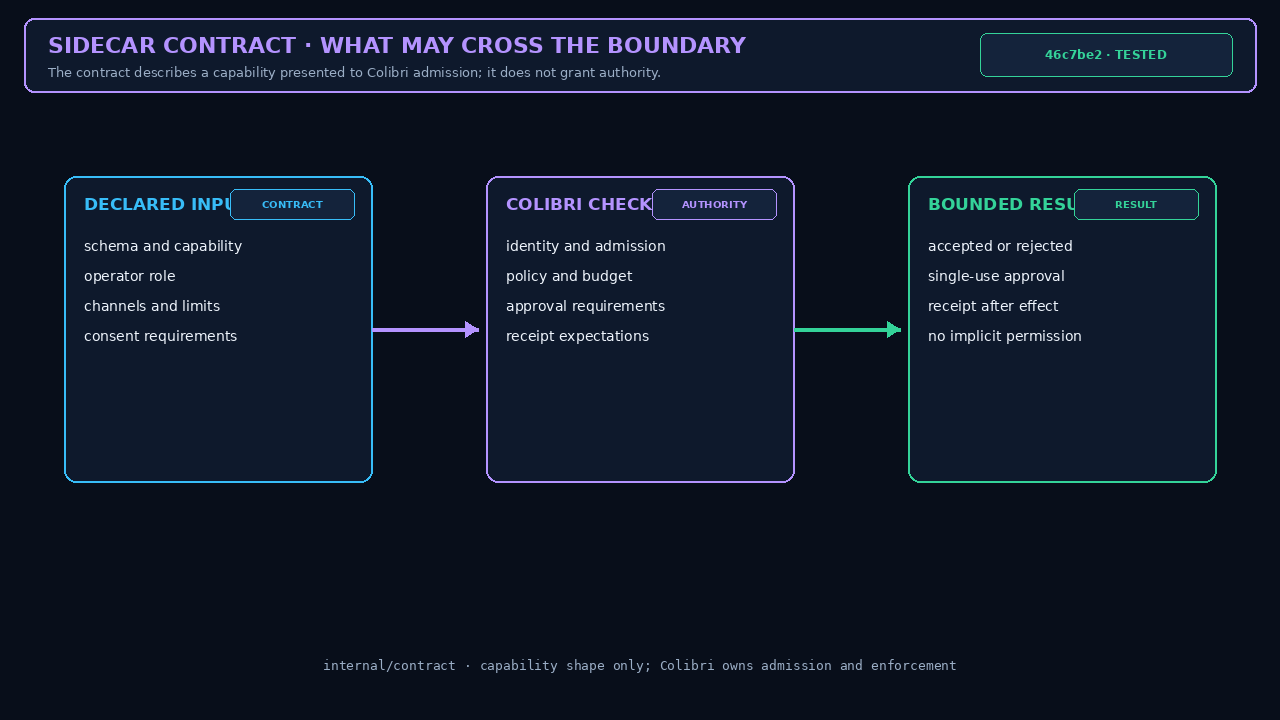 Figure 1: The sidecar presents a bounded capability contract. Colibri retains admission, policy, budget, approval, and receipt authority.
A second report track: energy, API spend, and the operator console
Section titled “A second report track: energy, API spend, and the operator console”The same session exposed a useful bridge between physical infrastructure and agent economics. The iLO power meter observes the host, while Colibri already records provider, model, tokens, cache use, and API cost for each task. These measurements should remain separate durable ledgers and meet only in a read-only operator projection.
Jev rated this architecture at 0.89 overall fit. Its bounded recommendation was consistent across every choice: Colibri owns the contracts and durable records, a host-side collector reads iLO, Plone renders the operator view, and A2A becomes a versioned cross-node transport only after the local contract is stable. The evaluation is advisory; these components are still a proposed implementation sequence.
| Layer | Responsibility | Boundary |
|---|---|---|
| iLO | Sensor | Produces host-level power and thermal observations; it cannot identify the energy consumed by an individual concurrent task. |
| Colibri | Ledger | Keeps energy observations and API task costs in separate immutable domains and joins them by host identity and UTC interval. |
| A2A | Envelope | Later transports an already-versioned observation between explicit nodes; it is not the source of truth. |
| Plone | Console | Shows trends, evidence, alerts, and drill-down as a read-only operator projection; it holds no BMC credentials. |
A verified device window contained 288 near-five-minute samples with an 85 W reported average and an 81–118 W range. Normalizing that average to 24 hours yields approximately 2.04 kWh. This is a derived engineering value, not a utility bill. Watts and watt-hours remain distinct from API dollars; a tariff conversion or per-task energy allocation must carry its method, time window, provenance, and confidence.
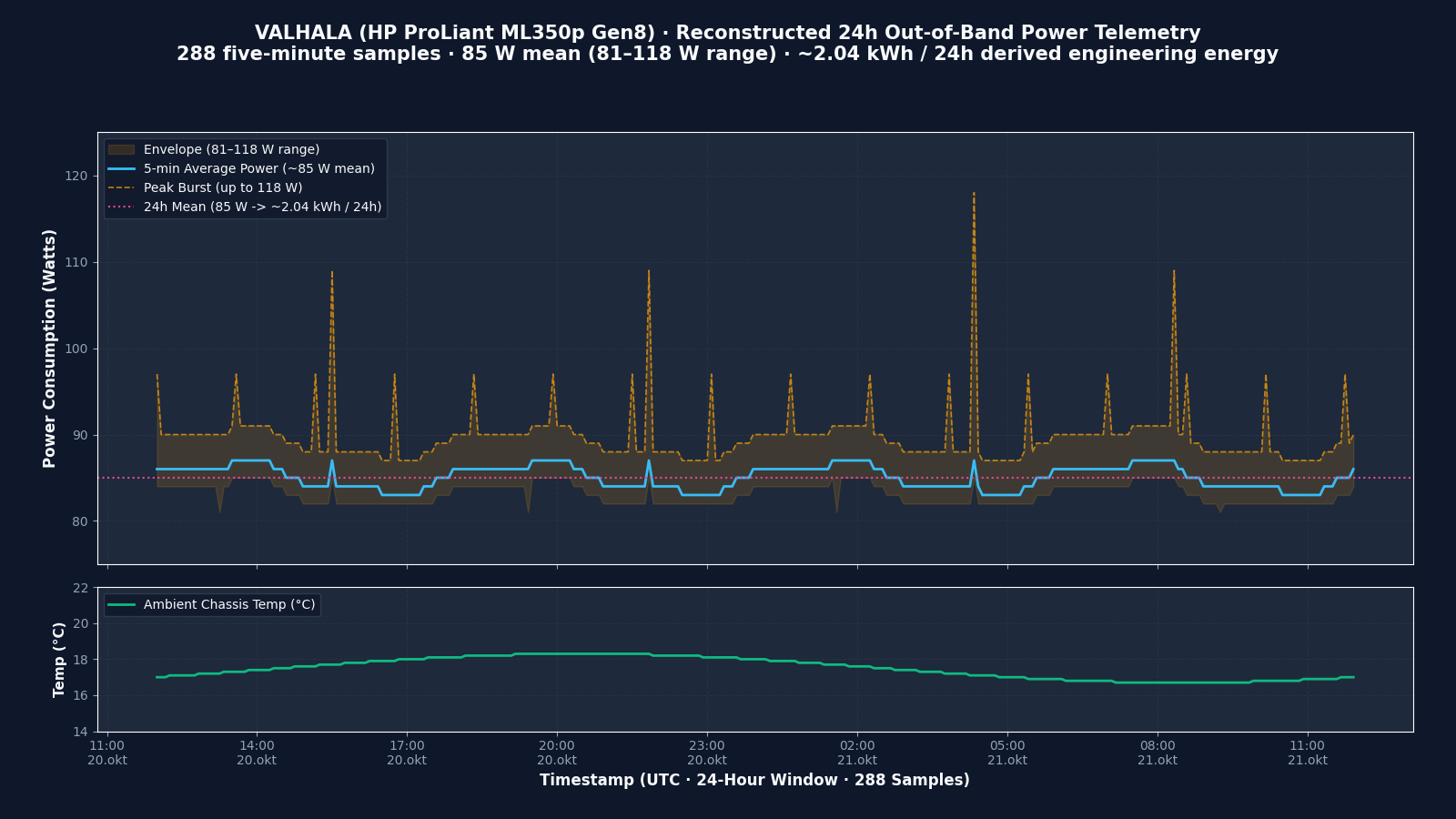 Figure 2: Reconstructed 24-hour out-of-band power and thermal telemetry panel (288 five-minute samples, 85 W mean, 81–118 W range, ~2.04 kWh derived 24-hour engineering energy) with zero private infrastructure identifiers.
The standalone 95-second storyboard and caption master are ready in Sensor, Ledger, Envelope, Console. It specifies a reconstructed telemetry panel because the source management screenshot contains private infrastructure identifiers and must not be published. No rendered-video claim is made yet.
Working boundary: iLO is the sensor. Colibri is the ledger. A2A is the envelope. Plone is the console.
Key architectural insights
Section titled “Key architectural insights”1. Transcript resume is not task durability
Section titled “1. Transcript resume is not task durability”Herdr excels at preserving terminal window continuity and process sessions — reopening a terminal displays past command output. However, that alone does not prove whether an external side effect (tool invocation, file mutation, API call) completed before a crash. True durability requires persisting intent before execution and an explicit replay policy (at-least-once with idempotency receipts).
2. The cross-store gap: agent.sqlite vs dna.sqlite
Section titled “2. The cross-store gap: agent.sqlite vs dna.sqlite”In the news agent project, agent tasks live in one SQLite database while domain news data lives in another. Because no distributed transaction bridges the two, crashing between model completion and receipt memoization can trigger duplicate calls. Colibri eliminates this with immutable admission (tenant_id, request_id, payload_digest).
Component responsibilities matrix
Section titled “Component responsibilities matrix”| Component | Durable Role | Invariant & Boundary |
|---|---|---|
| Colibri | Canonical admission & authority | Admits work exactly once, enforces identity, budgets, and owns authoritative receipts. |
| zot | Execution harness | Primary Go tool harness for model turns, PTY multiplexing, and RPC loops. |
| Pi Durable | Experimental sidecar | Validation of checkpoint semantics and state phases in an isolated lab. |
| bherdr / herdr | Terminal & session continuity | Preserves TTY and session continuity; does not own business task durability. |
| Jev | Typed advisory (System 1) | Fast semantic classifier (deny/escalate); raises scrutiny, never grants authority. |
| Operator | Ultimate decision | Sole sovereign authority for execution release, branch merges, and deployments. |
Go / No-Go gates
Section titled “Go / No-Go gates”We advance from the lab into operational integration only upon satisfying explicit criteria:
- Duplicate admission yields exactly one task and one evidence packet.
- Forced process termination (
kill -9) at any phase resumes or parks safely without repeating unconfirmed unsafe calls. - The sidecar has zero authority to mutate repositories or invoke deployment tools.
- Model and tool budgets are capped before admission.
Catch-up: what the implementation branch now proves
Section titled “Catch-up: what the implementation branch now proves”The branch adds three bounded layers:
internal/contractdefines the capability document a sidecar presents at admission. It does not grant authority; Colibri still enforces identity, policy, budgets, approval, and receipts.internal/taskderives task identity from canonical content and authority context. Reconciliation retries an intended but unapplied idempotent effect, while an applied effect without a recorded result moves toneeds_operatorinstead of running twice.FileStorewrites one JSON record per task using a same-directory temporary file,fsync, atomic rename, and directoryfsync.
Targeted race tests for internal/contract and internal/task pass on the inspected branch. This establishes implementation evidence for Slice 0. It does not establish a production deployment, a merged branch, or a completed Forgejo curator.