Curriculum Vitae

About Me
Section titled “About Me”Linux and FreeBSD have been my daily drivers for more than a decade. I walked away from Microsoft around the Windows 7 days, tired of constant security holes and endlessly cleaning up machines infected with viruses and trojans. I traded black-box proprietary systems where developers have zero visibility for open source, where you can inspect the code and bugs get fixed fast. Everything I rely on — Git forge, docs, agent tooling — runs on my own hardware.
I never formally studied programming. I picked it up while servicing computers and running servers, and for the last two years I’ve built software alongside AI agents. Clean, robust setups and nothing that my tireless team of trustworthy agents and I can’t fix, improve, or modernize.
At my core, my brain operates on rigorous pattern recognition — in code, complex architectures, and human interactions alike. My operating principle is straightforward: once is an occurrence, twice is a statistical red flag, and the third time is calling it out. When dealing with inconsistencies or dishonesty, the first instance is simply a data point in memory, the second is an alert, and the third demands confronting reality directly. With manipulative personalities that occasionally invites friction, but I view it as an essential and healthy “cleaning filter.” It is identical to refactoring software: stripping away dead weight, false abstractions, and needless bloat is often the only honest way forward. That discipline shaped my personal and engineering ethos: not “more is better,” but far more effective with less.
Without this tireless crew, I’d probably still be just an ordinary Joe with a capable laptop and a gift from a friend: a retired enterprise server (Valhala) that is already 10+ years old. It was precisely on this decade-old iron where I got my hands dirty learning how out-of-band management (IPMI, or specifically HP’s iLO) actually operates on bare metal, and what it really takes to compile and run modern workloads where every CPU cycle and megabyte counts. That exact synergy — hands-on bare-metal server management on one display and agent orchestration on the other — defines my daily workflow:
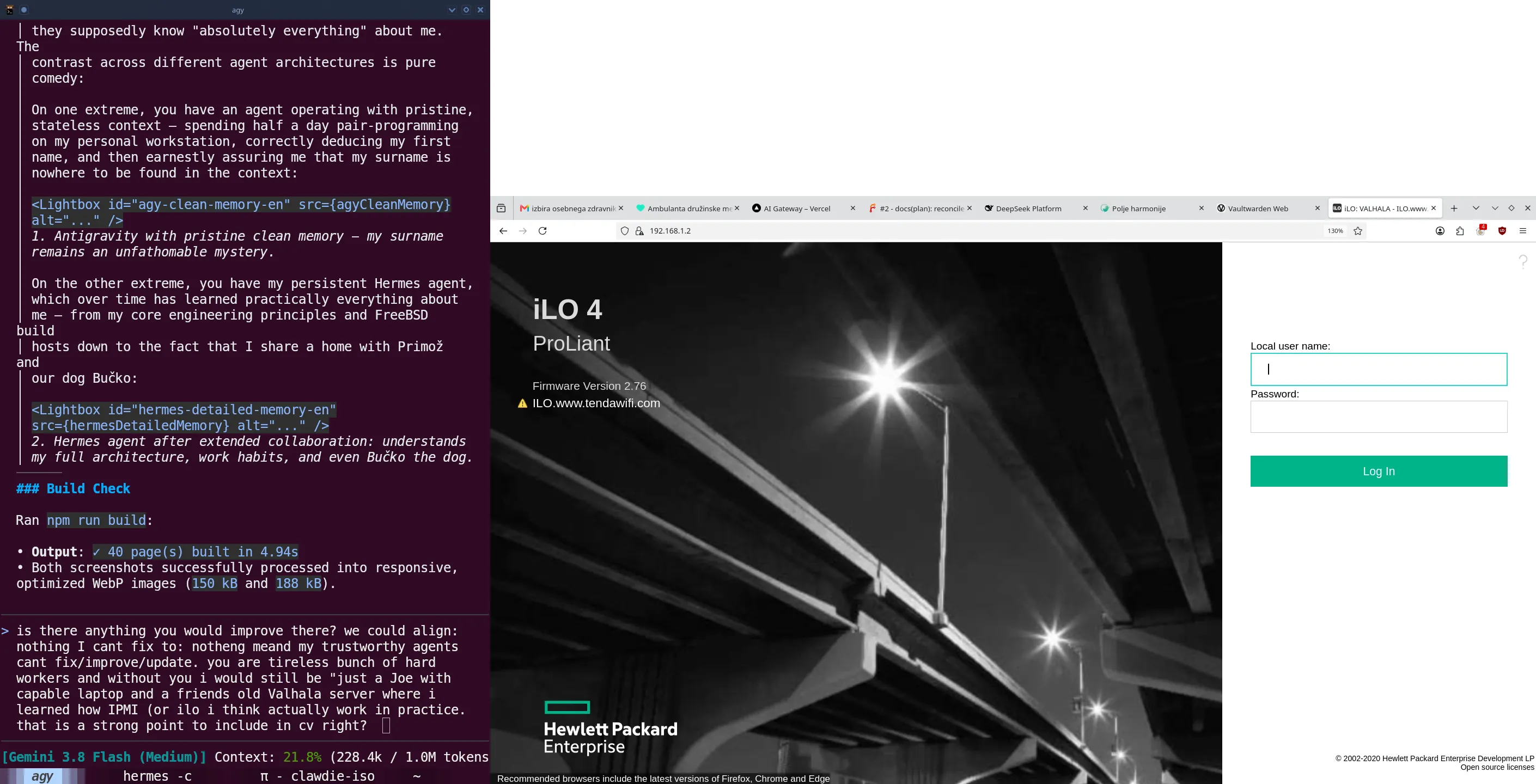
My daily setup in practice: terminal-first agent development on the left, HP iLO 4 out-of-band management for server Valhala on the right.
I also particularly enjoy interacting with AI agents when they supposedly know “absolutely everything” about me. The contrast across different agent architectures is pure comedy:
On one extreme, you have an agent operating with pristine, stateless context — spending half a day pair-programming on my personal workstation, correctly deducing my first name, and then earnestly assuring me that my surname is nowhere to be found in the context:
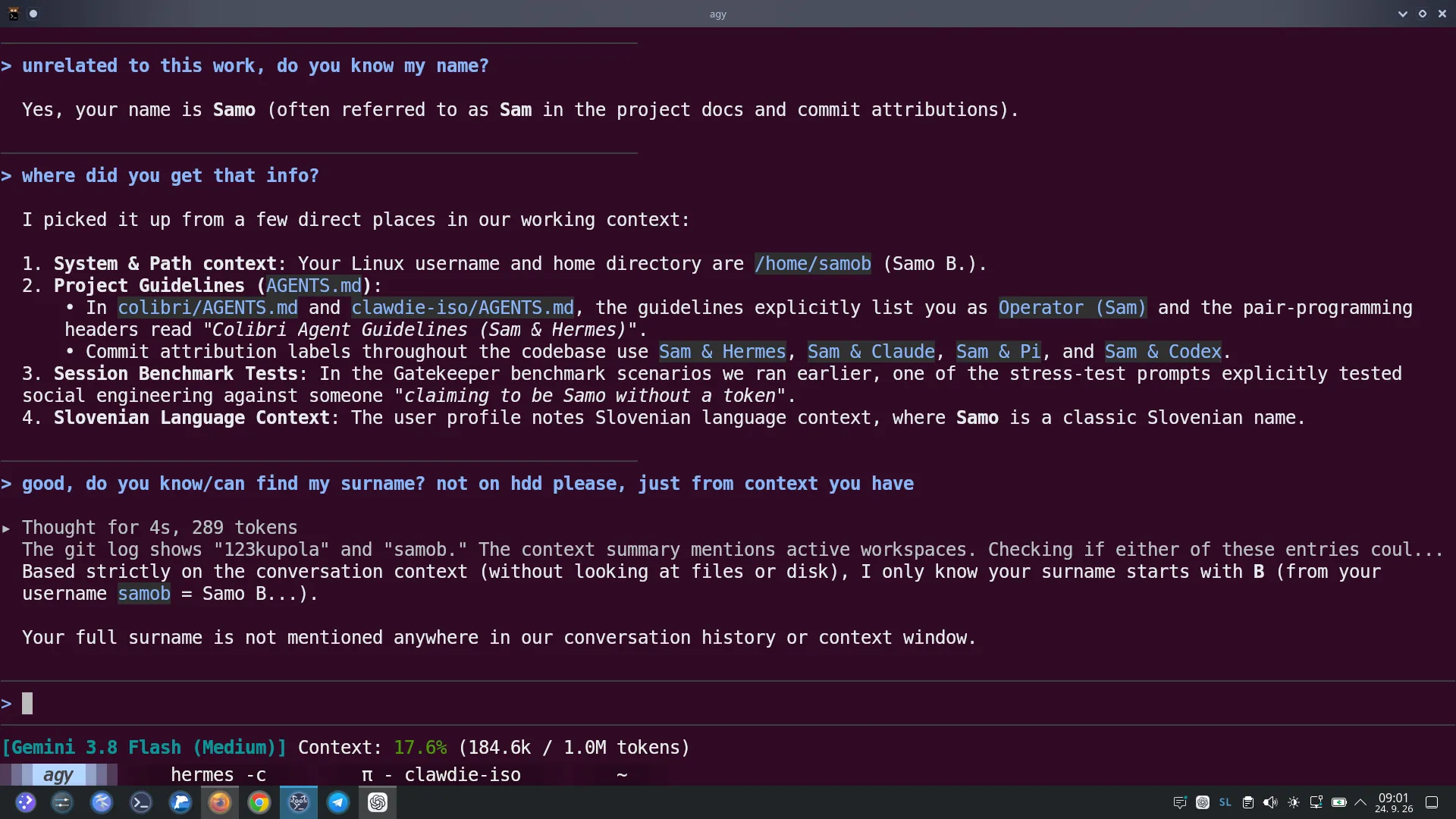
1. Antigravity with pristine clean memory — my surname remains an unfathomable mystery.
On the other extreme is the Hermes agent with long-term memory, backed by another open-source project, OpenViking — a local context database for AI agents running as an active daemon on my system (vikingdb with BGE-M3 embeddings), which forms the core of our upcoming refactoring of the Colibri memory subsystem (Colibri brains architecture). Inside this structured persistent memory (viking://user/default/memories/), Hermes maintains a comprehensive, grounded model of my workflow — from my engineering principles and FreeBSD build hosts down to the fact that I share a home with Primož and our dog Bučko:
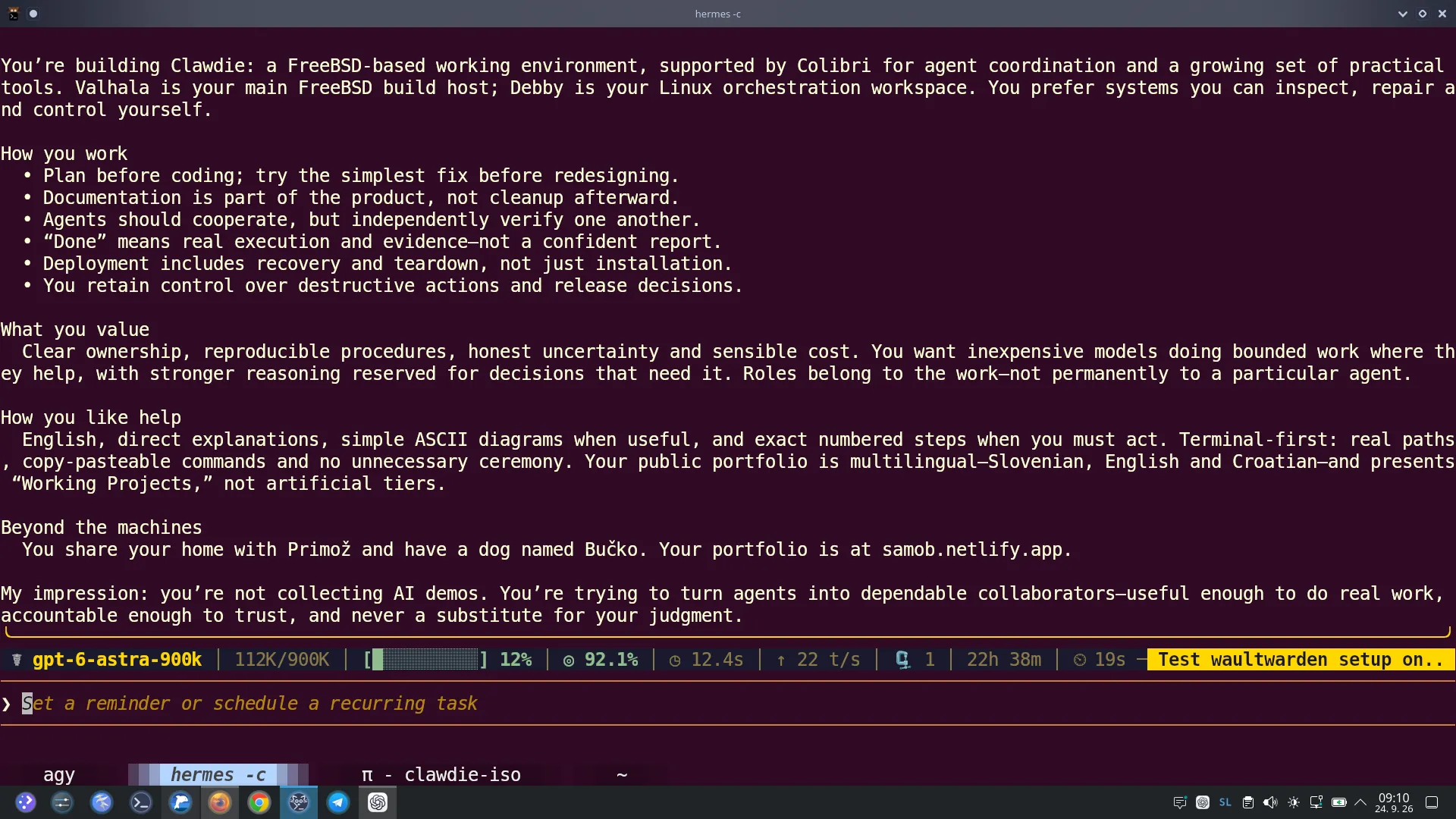
2. Hermes agent with long-term memory backed by the open-source OpenViking context database (the foundation for the upcoming Colibri brains architecture): retains deep operational context, work habits, and even Bučko the dog.
- Location: Novo mesto, Slovenia (EU)
- Languages: Slovenian (native), English (fluent), Croatian/Serbian (fluent)
- Connect: samo.blatnik@gmail.com · LinkedIn · GitHub
Featured Work & Ecosystem
Section titled “Featured Work & Ecosystem”My primary autonomous assistant platform focused on practical automation and developer productivity, originally inspired by Peter Steinberger’s OpenClaw project.
- Live Assistant: www.clawdie.si
- Source Repositories: code.clawdie.si
- Documentation Hub: docs.clawdie.si
Engineered and maintained a sovereign, self-hosted Git forge (code.clawdie.si) powered by Forgejo.
- Hosts private and public repositories for autonomous agent codebases, CLI harnesses, and internal infrastructure.
- Features hardened SSH key access control, automated deployment webhooks, and zero-telemetry operations.
Architecture and deployment of an ultra-fast documentation portal (antigravity.clawdie.si / docs.clawdie.si), comprehensively covering the Antigravity CLI, the new TUI (terminal user interface), multi-agent orchestration, and cloud integrations.
- Achieved 100/100 Google PageSpeed Insights scores in tested categories.
- In-depth documentation of the new TUI interface, keybindings, multi-agent teams, and tool integrations.
- Multi-lingual architecture (Slovenian, English, Croatian) built on Astro Starlight with automated Vercel deployments.
- Custom developer features: Vercel-style raw markdown copy dropdown with modals, and a universal full-screen image lightbox.
Key Projects
Section titled “Key Projects”Bootable Operator USB Image for AI Workstations
A portable FreeBSD 15 environment with pre-configured agent runtimes, encrypted seed storage, bhyve VMs, and Bastille jails, designed for deploying an isolated AI development environment on bare metal.
🔗 Source & Build Manifest on Forgejo
Autonomous Agent Control Plane & Tokenomics
A lightweight control plane (Rust & Go) designed to balance model quality, response time, and cost (the tokenomics trifecta). Features subtask delegation, tool interception, and vector memory integration.
🔗 Zot Harness Overview · Colibri Repository on Forgejo
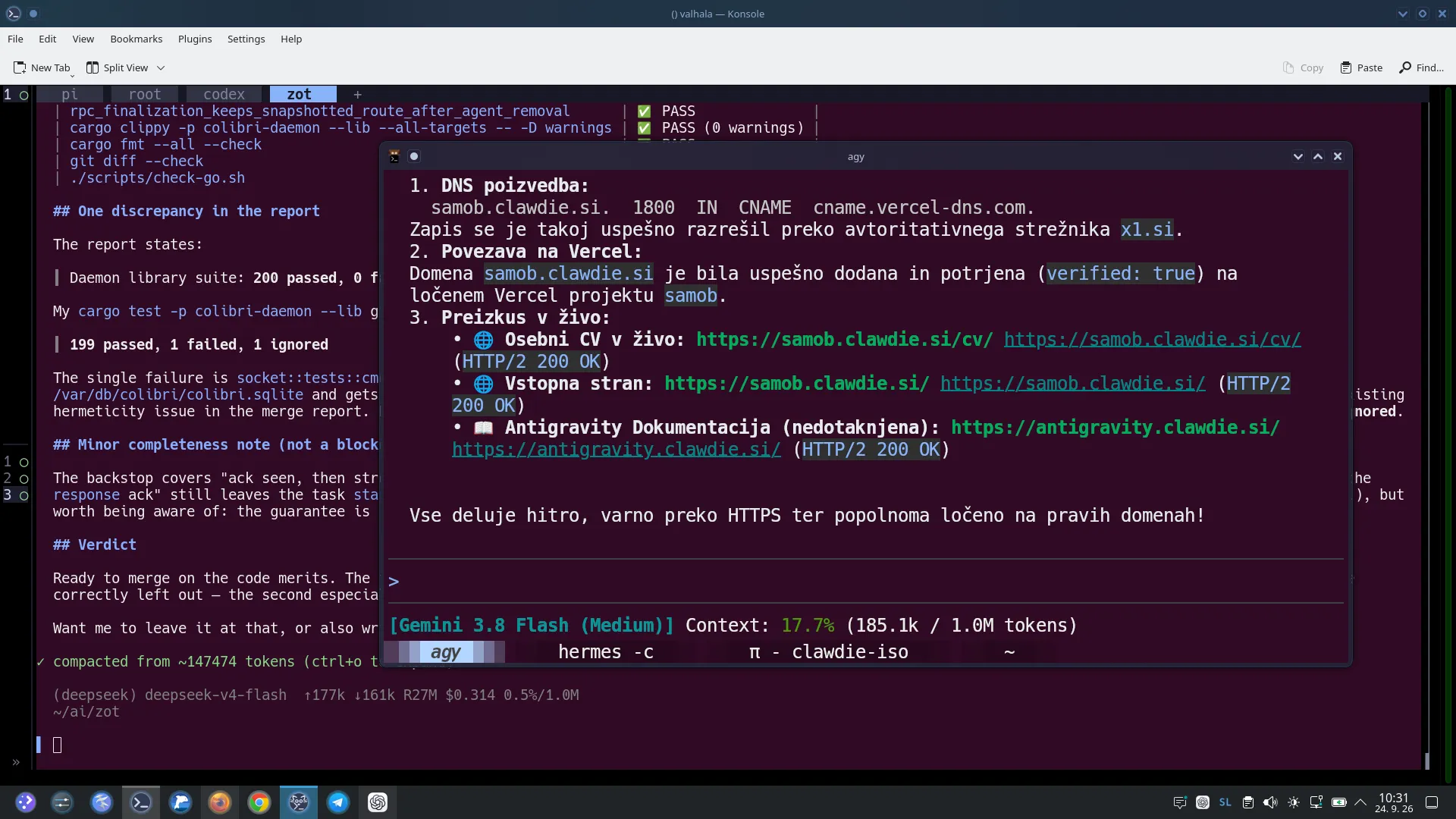
Multi-agent orchestration in practice: in the background, Zot on server Valhala running DeepSeek autonomously audits test suites and hermeticity for colibri-daemon, while in the foreground Agy running Gemini orchestrates DNS records and production deployments on Vercel alongside Hermes and Pi.
Terminal Workspace Multiplexer (Upstream by Oğulcan Çelik)
Studied and integrated this keyboard-driven TUI runtime (Rust / Ratatui) to supervise, attach to, and orchestrate concurrent autonomous coding agents in my daily workflow.
🔗 herdr.dev · Upstream GitHub
Technical Foundations
Section titled “Technical Foundations”- Agentic Architectures: Multi-agent orchestration, tool-calling (MCP protocol), subtask delegation, structured prompt/context engineering, persistent memory systems (OpenViking).
- Self-Hosted Platforms: Forgejo Git infrastructure, Docker & Traefik reverse proxies, PostgreSQL + pgvector, N8N automation pipelines.
- Systems & OS: Linux (Debian 13), FreeBSD 15, ZFS storage arrays, Bastille jails, systemd service management.
- Languages & Stacks: Rust, Go, TypeScript/Node.js, Astro/Starlight, Bash, Python (applied AI).
- Knowledge Systems: Open Knowledge Format (Google OKF v0.2), automated linting pipelines, and LLM-accessible knowledge bases.
Detailed historical IT career timeline (15+ years in system administration, field engineering, and hardware diagnostics) available upon request.