19.oct.2026
Illustrative framing scene (fictional motif): The following dialogue is a design scene. It records a proposed interface and does not claim working hardware, production readiness, checkout, or fulfillment.
Operator: Lisica should not be trapped inside a watch. She needs to move as quickly as the message she carries.
Clawdie: Then the first object is a small field surface. It can sit on a wrist, hang from a lanyard, clip onto a badge, or pass from one person to another at a conference.
Jev: A full MCP session on that tag would expand the trust boundary. Service credentials, discovery, and execution do not belong on an easily lost object.
Agy: Terminate MCP in the trusted local adapter. Send each wearable only one short-lived quorum challenge and accept one bounded signature in return.
Lisica: I do not carry the fortress key. I carry one holder’s approval key, and my vote opens nothing without the other two.
Operator: Give her an ink-like screen, long idle life, and just enough motion to refresh when the state changes.
Clawdie: Recorded as a three-card family kit. The customer chooses three trusted holders; the product, payment, radio, and manufacturing implementation remain open.
Clawdie Compiler Intake Receipt (19.oct.2026)
Section titled “Clawdie Compiler Intake Receipt (19.oct.2026)”| Workstream | Claim Scope | Verification Status | Canonical Evidence |
|---|---|---|---|
| 1. Lisica naming | Lisica becomes the canonical character name; “fox” remains an English species gloss and stable route slug | Branch-Staged | Identity baseline f24a403 · this diary entry |
| 2. Wearable form | Lisica is provisioned as a three-card family kit; the customer assigns one card to each trusted human holder | Product decision | Three-card pilot contract |
| 3. MCP boundary | Full MCP ends in the trusted adapter; each card holds one hardware-bound approval key and signs one challenge | Proposed | Quorum protocol sketch below |
| 4. Commercial boundary | The planning envelope is ten customers, ten isolated Valhala jails, and thirty cards; capacity remains unverified | Proposed pilot | Existing Colibri ten-customer cap; no live enrollment or physical fulfillment authorized |
| 5. Petelin forge | Colibri PRs #192, #193, and #194 landed the passive daemon, patched Go line, and CI vulnerability gate | Verified live | Exact PR heads report five successful checks; evidence manifest |
| 6. Lisica scenarios | The earlier Jev pass informed the form; the operator subsequently fixed the product as three assigned cards | Operator decision | jev-latest scenario result |
| 7. Tarsnap boundary | The operator-domain worker holds the restricted Tarsnap key; three Lisica holders ratify sensitive requests | Proposed | Focused Jev result · official Tarsnap docs |
| 8. Video source | The meta report has a timed, multilingual evidence-to-concept shot plan | Preproduction | Machine-readable storyboard |
Petelin: what left the forge
Section titled “Petelin: what left the forge”Petelin’s part of the report uses live Forgejo evidence rather than a decorative terminal. Three successive Colibri pull requests form one build story:
- PR #192 merged the passive Go daemon and its private socket, peer-authentication, read-only readiness, and root-refusal boundaries.
- PR #193 moved the project to the patched Go 1.26.9 toolchain and refreshed direct dependencies.
- PR #194 made CI derive its Go floor from
go.modand require the pinned vulnerability scan.
The exact head of each PR reports the same five successful checks: markdown, packaging, Python tests, Go, and leak guard. The screenshots below were captured anonymously from the public Forgejo pages on 19.oct.2026; their URLs, commit IDs, status, and SHA-256 digests are recorded in the forge evidence manifest.
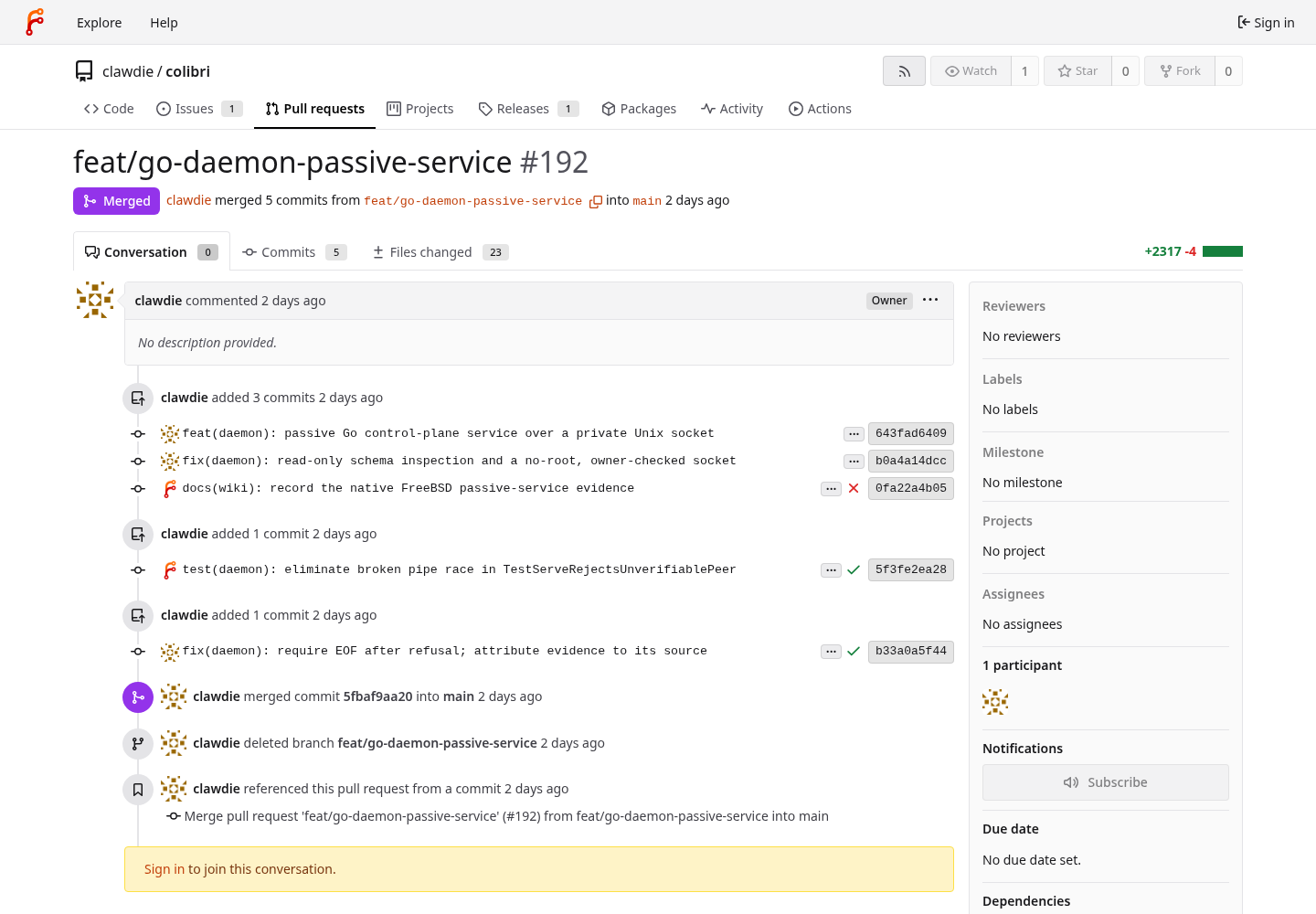
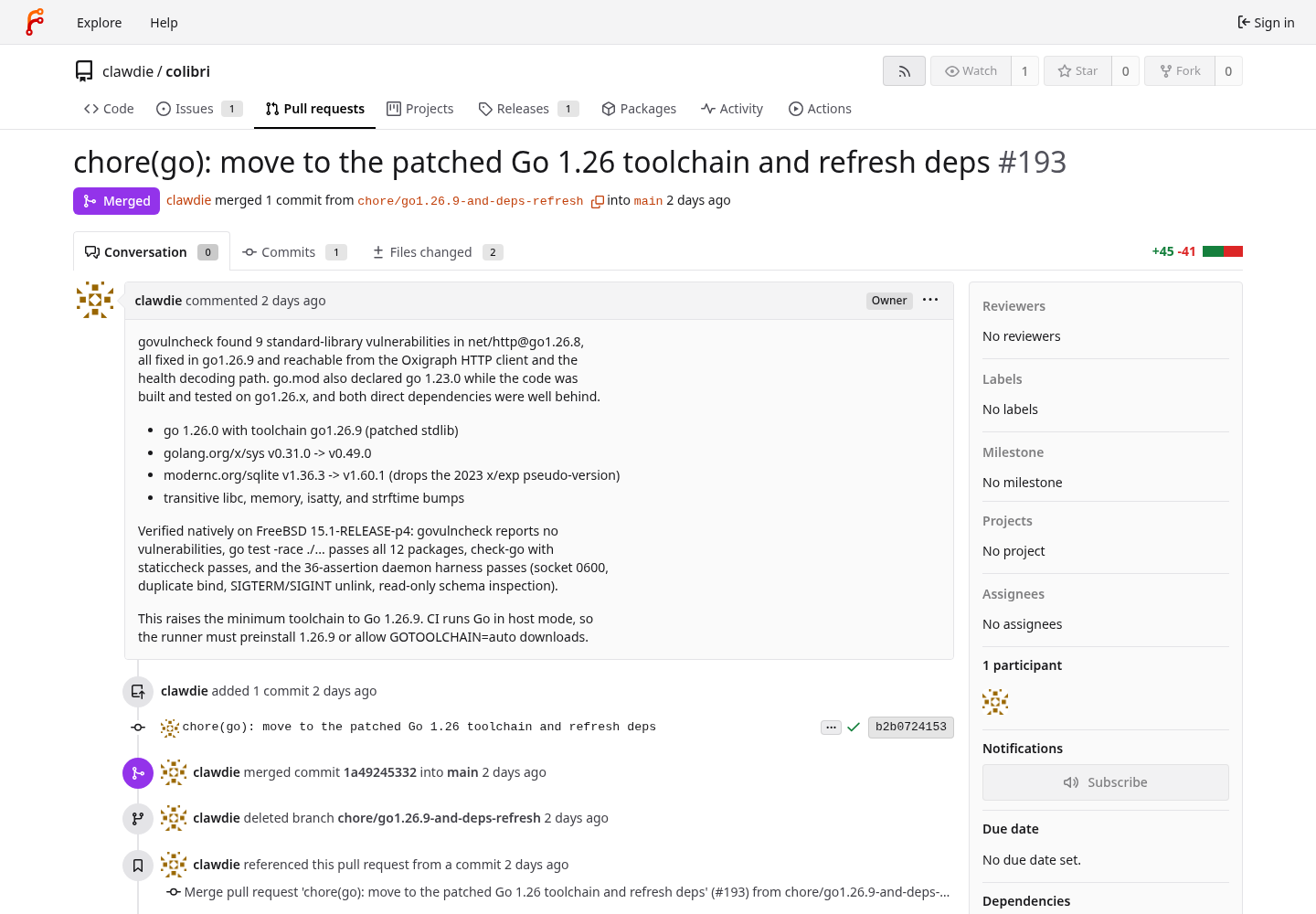
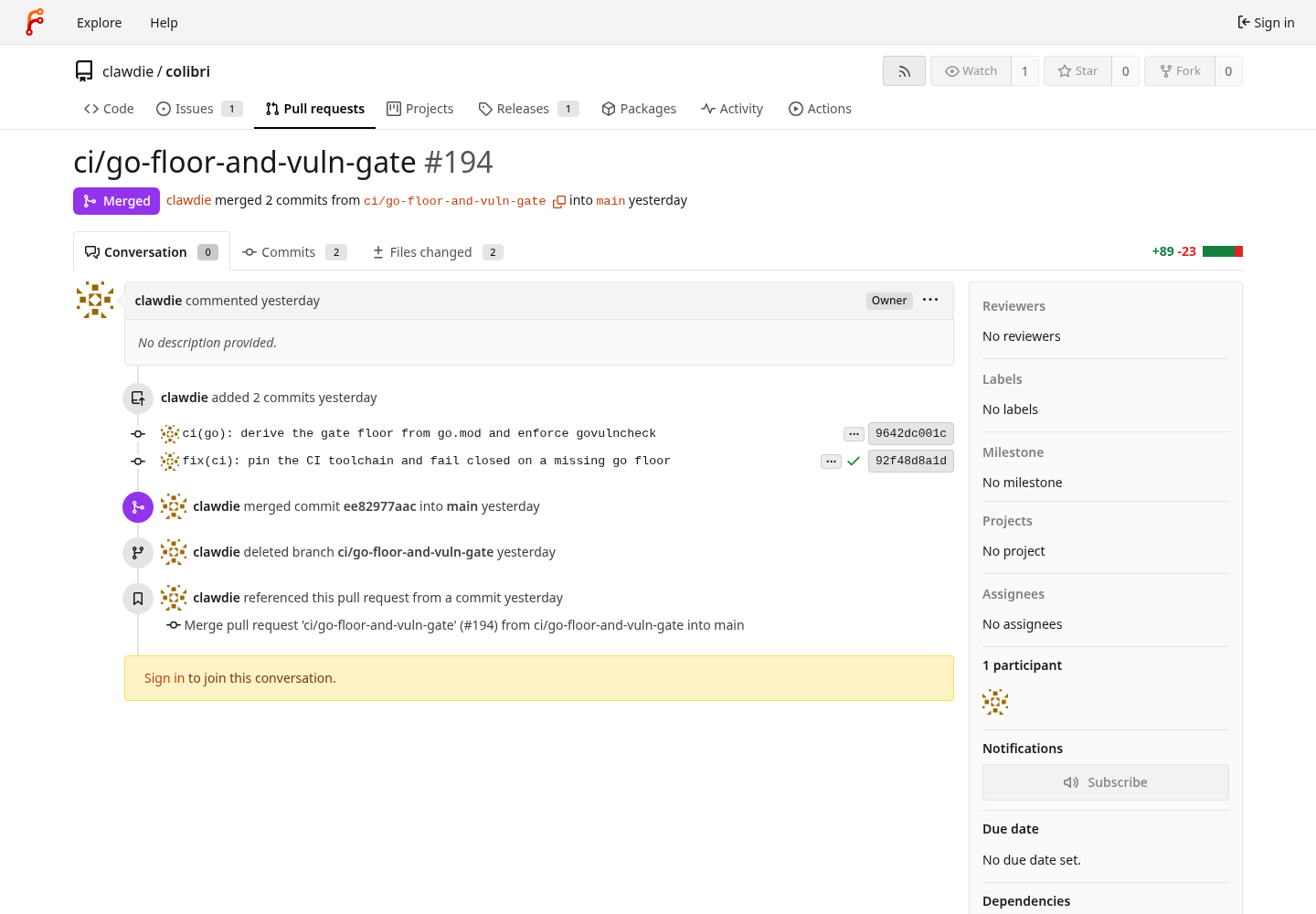
In the video, each screenshot begins at one quarter of the frame inside Petelin’s fire-separated forge, then briefly fills the frame when the narration names the merged boundary. This keeps the forge grounded in reviewable work while the surrounding workshop remains the visual metaphor.
Jev pass: forms before authority
Section titled “Jev pass: forms before authority”The first Jev pass selected presentation messenger as Lisica’s core role with probability 1.00. It also judged it safe to show the device and service ideas as explicitly proposed scenarios (0.86). Credential custody was the leading risk (0.86 probability), which supports the existing rule that Lisica never carries a service key.
The form ranking is useful but not decisive. The e-ink display led at 0.44, followed by a phone-hosted local adapter at 0.31 and a public conference tag at 0.24. Because the selected answer’s confidence was only 0.30, this remains an exploratory ordering rather than a product decision. The consortium scenario ranked as later protocol work: explicitly configured peers, signed and expiring recipes, no scanning, and operator approval before a recipe can become permission.
This gives each form a clean job:
- Phone: hosts the trusted local presentation and approval interface; it does not grant itself authority.
- E-ink tag: receives a short-lived sanitized display envelope from the local adapter.
- Conference badge: shows a public capability card or QR, never a private endpoint or enrollment secret.
- Consortium messenger: later carries bounded recipes only between explicitly configured peers.
The input packet and typed result are kept beside the report. Jev supplies a prior for the design review; it does not authorize a device, credential, merge, or deployment.
Operator decision: a three-card family kit
Section titled “Operator decision: a three-card family kit”The product is now deliberately packaged like a family loyalty-card account. One customer receives exactly three Lisica cards and chooses three people trusted with the keys to the fortress. Each card has a separate identifier, holder slot, and proposed non-exportable approval key. The customer account binds the three public keys; the private keys remain inside their cards.
The existing Connected Mothers rule remains human: three neighboring operators must all cryptographically ratify an irreversible transition. The cards prove their holders’ votes. They do not manufacture independence by themselves, so three cards kept by one person do not satisfy the quorum.
customer account      │      ├── Lisica I   → trusted holder A      ├── Lisica II  → trusted holder B      └── Lisica III → trusted holder C
irreversible request → three bounded challenges → three human signatures → ratified
A card may display routine status without quorum. For an irreversible transition it signs only a digest, expiry, transaction identifier, and explicit ratify or reject response. One card cannot authorize anything alone. A missing or revoked card fails closed until an operator-reviewed replacement ceremony completes. The machine-readable three-card contract records this product decision without claiming implemented hardware.
“Give us Tarsnap access” without giving Lisica the key
Section titled ““Give us Tarsnap access” without giving Lisica the key”Tarsnap does not use a lightweight bearer token that belongs on a wearable. Its machine key file contains the material needed to create and access archives, and the official setup guide warns that losing the only copy makes restoration impossible. Tarsnap can, however, derive restricted key files with separate read, write, delete, and nuke permissions. A write-only key can create archives without reading or deleting them. See the official getting-started guide, security model, and tarsnap-keymgmt(1).
The useful scenario therefore becomes:
operator reviews and registers the machine │ ▼operator-domain worker receives a machine-specific write-only Tarsnap key │ ▼bounded backup request is sent to Lisica I, II, and III │ ▼three assigned human holders sign the same expiring challenge │ ▼deterministic policy verifies 3-of-3 and releases the job to the worker │ ▼Lisica returns the backup receipt; no card ever sees the Tarsnap keyRestore and delete authority stay in a separate, human-reviewed path. The phone, badge, and e-ink tag never receive the key file. The broad probe’s raw-Tarsnap score was internally inconsistent with its own risk and authority answers, so it was discarded rather than treated as approval. A focused second Jev probe chose this host-worker model with probability 1.00, selected the phone as presentation and approval UI with 0.99, and assigned 0.88 to explicit human review before real key provisioning. The full probe packet and result remain reviewable.
For the video, the friendly promise is: “Three people hold the three Lisice. The fortress keeps its Tarsnap key. When all three approve, Lisica brings back the receipt.” It preserves the family-card simplicity without turning a wearable into a service-credential custodian.
Ten-customer Valhala pilot envelope
Section titled “Ten-customer Valhala pilot envelope”The existing Support Colibri proposal already sets a hard cap of ten customers, manual enrollment one at a time, and native FreeBSD validation in isolated Valhala jails. That makes the first planning envelope easy to count: 10 customer jails and 30 Lisica cards.
This is a product and validation ceiling, not measured capacity evidence. The complete customer path, credential isolation, rollback, and ten-jail coexistence test have not run yet, and live enrollment is not authorized. The current Colibri network contract also keeps the control plane off Valhala, so Valhala is the proposed pilot execution and validation host unless that architecture is separately changed.
The report that records its own source
Section titled “The report that records its own source”The storyboard opens on this diary before its video exists, walks into Petelin’s forge through the three merged PRs, introduces the three-card Lisica quorum and Tarsnap separation, counts the ten-customer Valhala pilot envelope, then returns to the page after the evidence has been recorded. Every shot carries a visible status label: merged evidence, operator decision, or proposed pilot. The final video is still in preproduction.
Lisica, not Fox
Section titled “Lisica, not Fox”The ninth provisional character now has one canonical name: Lisica. “Fox” remains useful as an English translation and as the stable /fox/ route slug, but the character name stays Lisica in Slovenian, English, and Croatian.
This also sharpens her role. Lisica is not another local bridge, an authority, or a miniature Clawdie. She is the fast messenger between a trusted local MCP adapter and a small human-facing surface. Clawdie still compiles the report; Lisica carries a deliberately reduced challenge, one holder’s bounded signature, or a receipt.
A wearable, not necessarily a watch
Section titled “A wearable, not necessarily a watch”The first prototype should use one card-sized e-ink core repeated as a three-card customer kit rather than commit to a smartwatch:
- a wrist strap can make it feel watch-like;
- a lanyard or magnetic clip can turn it into a conference badge;
- a plastic card carrier can make the family-account relationship immediately familiar;
- the display can remain asleep for long periods and refresh only when its visible state changes.
The ink-like display language fits the identity system better than a bright miniature phone screen. The core should remain readable in daylight, calm when idle, and useful without constant animation.
Where MCP stops
Section titled “Where MCP stops”The wearable should not run the complete MCP trust boundary. The proposed path is:
Colibri or Clawdie local service │ ▼trusted Lisica presentation adapter │ ▼short-lived sanitized quorum challenge │ ▼Lisica card displays digest and asks its assigned holder │ ▼one bounded approval signature returns to the verifierThe first prototype is display-and-sign only. Its challenge must not contain API keys, bearer tokens, private addresses, hidden topology, executable tool calls, Tarsnap material, or durable personal history. Each card holds only its own hardware-bound quorum approval key. Losing one card cannot grant unilateral access and blocks 3-of-3 transitions until replacement.
A draft envelope can remain deliberately small:
{ "schema": "clawdie.lisica-quorum-challenge.v0", "holder_slot": 1, "challenge_digest": "sha256:…", "expires_at": "short-lived timestamp", "allowed_responses": ["ratify", "reject"]}This is a design sketch, not an implemented wire contract. Authentication, transport, replay protection, radio selection, and signed provenance remain open engineering work.
Visual direction
Section titled “Visual direction”Lisica owns the physical object. Her orange silhouette and white-tipped tail can identify the shell or printed back, while the e-ink face uses a restrained black-and-white version of the geodesic mark. The three cards form a numbered triptych—Lisica I, II, and III—with equal visual weight. The other eight field identities may appear as compact status glyphs, but they do not become execution permissions.
The first design package should contain:
- front, back, side, lanyard, and wrist-carrier views for all three numbered cards;
- daylight and dark-room e-ink states;
- a dimensioned shell, strap or clip attachment, and printable vector outline;
- the challenge-and-signature boundary, holder-assignment ceremony, and lost-card replacement path;
- power and refresh assumptions, clearly labeled as estimates;
- an explicit concept prototype label with no checkout, preorder, shipping, or functional-device promise.
Today establishes the story and the boundary. A later prototype can decide whether Lisica communicates through NFC, Bluetooth Low Energy, a dock, or another constrained link after the power and threat models are measured.
Identity media index
Section titled “Identity media index”The identity marks now have a home for their meaning that is not a second copy of their bytes. layered-soul carries IDENTITY-MEDIA.md: one row per mark with its role, frame, vector path and a sha256[:16] digest pinned to this repository at 52848c2. The vectors and rasters did not move — the site remains the only place they render.
The walkthrough above ends on two scenes about it: the epilogue from 2:24.
Three parts of one decision:
- One source of truth. Copying the vectors into the soul repository would create a second truth that drifts from the one the site renders.
- Verified, not assumed. Twelve digest rows were re-hashed against
52848c2: zero mismatches. One legacy file stays unindexed because it is byte-identical to the Watchdog — the old duplicate, not a mark. - Defaults, not requirements. The dog is our example, not a rule. Anyone adopting the system may bring a cat, rename the roles, or redraw the marks. The system says what we meant, never what someone else must mean.
The brand line that carries it: We do not enforce. We experiment.
| Claim | Evidence |
|---|---|
| Index | layered-soul IDENTITY-MEDIA.md · commit 3033f47 |
| Digests | 12 rows re-hashed against samob@52848c2 · 0 mismatches |
| Neutrality | IDENTITY-MEDIA.md § Neutrality · AGENTS.md persona policy |
| Media | 157.8 s walkthrough · 12 scenes · WebVTT en/sl/hr · storyboard.json |
Tarsnap boundary: a rehearsal with synthetic keys
Section titled “Tarsnap boundary: a rehearsal with synthetic keys”The write-only worker boundary is the one part of the Lisica story that touches real backups, so it gets a rehearsal before it gets a key. The film below uses synthetic key files, not Tarsnap: no account key exists on this host, and nothing here ran against a real archive.
The manual decides the shape. From tarsnap-keymgmt(1): -r lists and extracts, -w writes, -d deletes and implies -r — you cannot delete one archive without reading it — and --nuke deletes all of them. A write-only worker therefore gets -w and nothing else, because every other flag is at least read-capable.
| What the rehearsal shows | What it does not show |
|---|---|
-w is the only append-only right | Tarsnap’s own enforcement of that key |
| read, delete, nuke and mixed rights are refused before execution | derivation of a real key from the account key |
| an expired challenge, a replay, or two of three signatures fail closed | a successful restore or a verified archive |
| the operator holds the account key, the worker holds one right | that the host running this is the host that will run the worker |
To be continued… Tomorrow: derive the real -w key on Asgard, with the operator, on the host that holds the account key, and move this rehearsal into CI so the refusals stay true after today. And the landing page: there is no Join the hive button today — clawdie.si offers Follow the build and Support. Tomorrow decides the call to action, and a subscribe form only ships once a real sender, double opt-in and an unsubscribe path exist.
A mailing list is not implemented.
hello@clawdie.sireaches the operator today; we will not publish a form that writes nowhere. If a list is wanted, it starts as one honest address and a documented path, not a promise.