14.oct.2026
Following yesterday’s revised plan, today we executed the disposable Agent Vault pilot on Valhala. The tested scope was one synthetic credential, an unprivileged curl client, and a local TLS mock in separate jails. The canonical Colibri receipt contains the verdicts, hashes, logs and runtime corrections; PR #162 remains under review.
Repair the operator tools first
Section titled “Repair the operator tools first”The existing doas rules allowed command basenames but missed their explicit paths: pfctl worked while /sbin/pfctl requested authentication. We backed up the policy, added absolute-path equivalents for the existing operational grants and tested them from the unprivileged account. Shell, copy/install and zot activation remained password-gated. Privileged pilot setup used the root console supplied by the operator.
Pillow and DejaVu fonts enabled the existing tmux-screenshot skill. Capture used a dedicated tmux socket and never interrupted the operator’s session. Asgard received no SSH access to Valhala.
One build, three runtime jails
Section titled “One build, three runtime jails”We compiled the pinned Agent Vault source once inside agentvault-build, copied only the static executable into the broker, checked matching SHA-256, then removed the build jail and its temporary network before generating credentials.
The runtime topology contained agentvault-broker, unprivileged agentvault-agent, and agentvault-mock-upstream, each with a separate VNET stack and its own Packet Filter rules. Their private bridge had no host address, uplink, NAT, mesh interface or default route. No host data was bind-mounted.
The agent’s role was no-access, with only a pilot:proxy vault grant. Client trust was scoped with curl --cacert; the broker trusted the TLS mock only through its own process configuration. System trust bundles stayed unchanged.
Measured results
Section titled “Measured results”| Check | Observed result |
|---|---|
| Credential injection | MOCK_OK; the mock saw the expected credential and no proxy-auth header |
| Secret reads and cross-vault access | Both reveal requests returned 403; cross-vault CONNECT returned 403 |
| Certificate trust | Explicit CA succeeded; omitting it returned curl 60 |
| Streaming | Five ordered chunks arrived progressively over about two seconds |
| Direct broker bypass | Connection failed, PF drop counter rose 0 -> 1, and the live mock received no request |
| Fail-closed rollback | Emptying the allow anchor blocked broker access; restoring it restored the broker path while direct bypass stayed blocked |
| Restart and cold restore | Original token, CA and grant still worked; negative tests repeated |
| Token revocation | Proxy 407, API 401, zero active tokens and no new mock request |
| Teardown | No pilot jail, dataset/snapshot, mount or interface remained; host PF matched baseline |
The failures belong in the record
Section titled “The failures belong in the record”The first jail start used the wrong FreeBSD path: /usr/bin/true is correct. Bastille could return zero even when a jail failed to start, so we checked actual jail and endpoint readiness. Offline packages needed a temporary static pkg helper and recursive discovery under All/Hashed. Login-shell fortune output contaminated token-only output, so scripted token capture used a non-login shell.
This curl version returned 7 for explicit CONNECT denial and immediate PF drops. We checked the reported HTTP status, live control request, drop counter and mock log instead of accepting one assumed exit code. VNET teardown also required waiting for dying jails and their interfaces before restart. Failed attempts were quarantined and corrected before continuing.
A 40-second visual receipt
Section titled “A 40-second visual receipt”Thirteen terminal captures preserve progress, failed attempts and passing checks. Secrets were excluded from the captures and logs; generated credentials and private state were destroyed during teardown.
MP4 recording · Looping GIF · Individual capture index
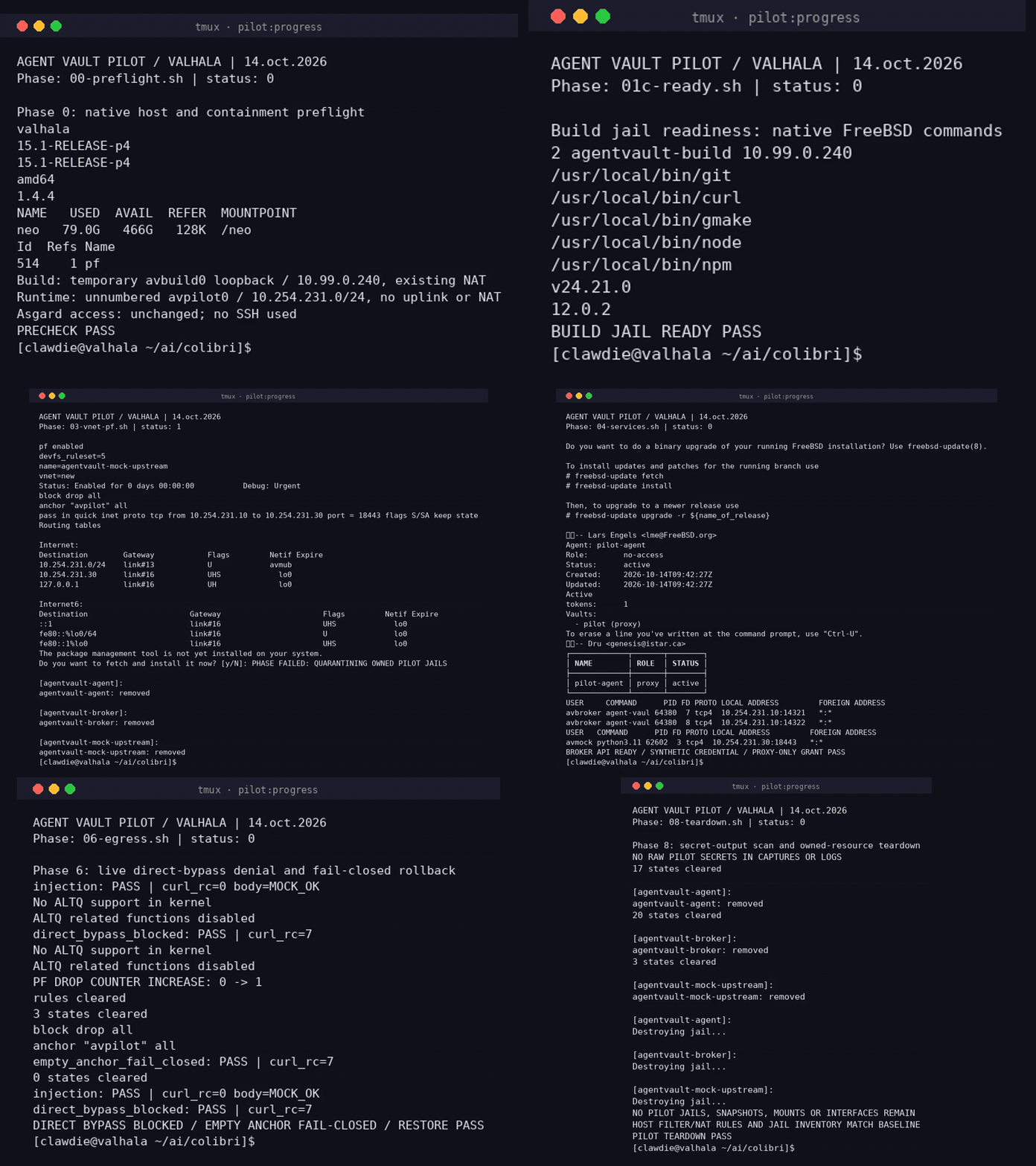
View all 13 captures
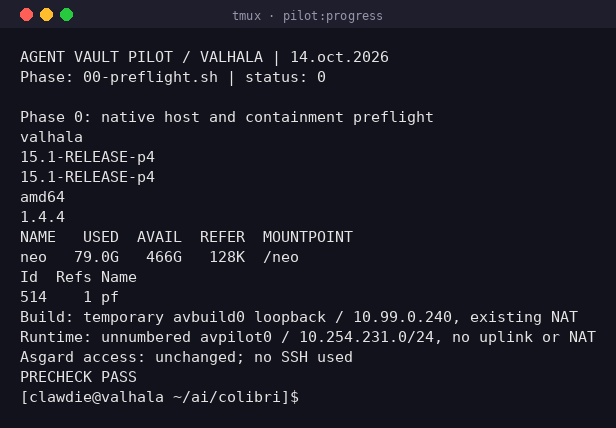
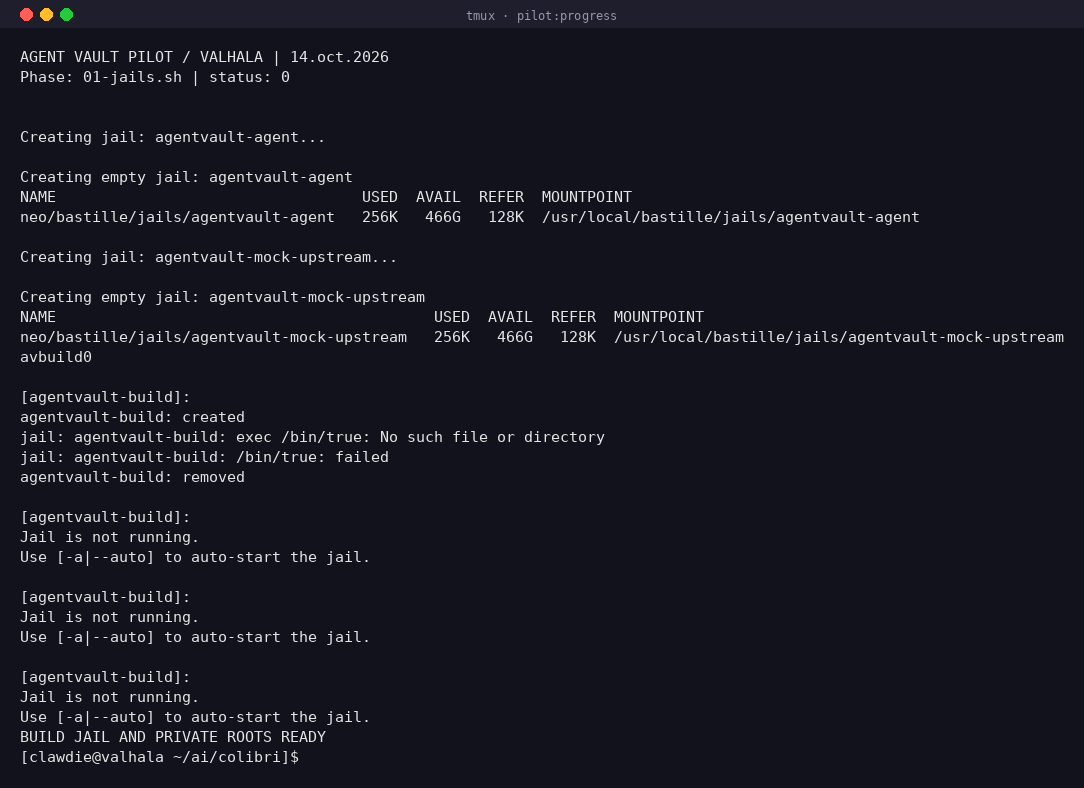
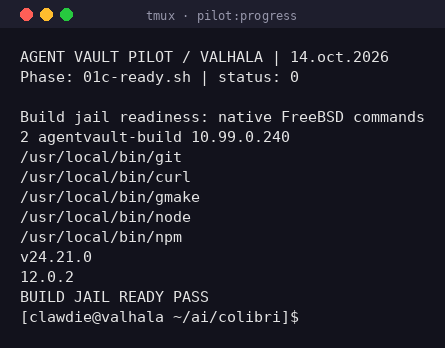
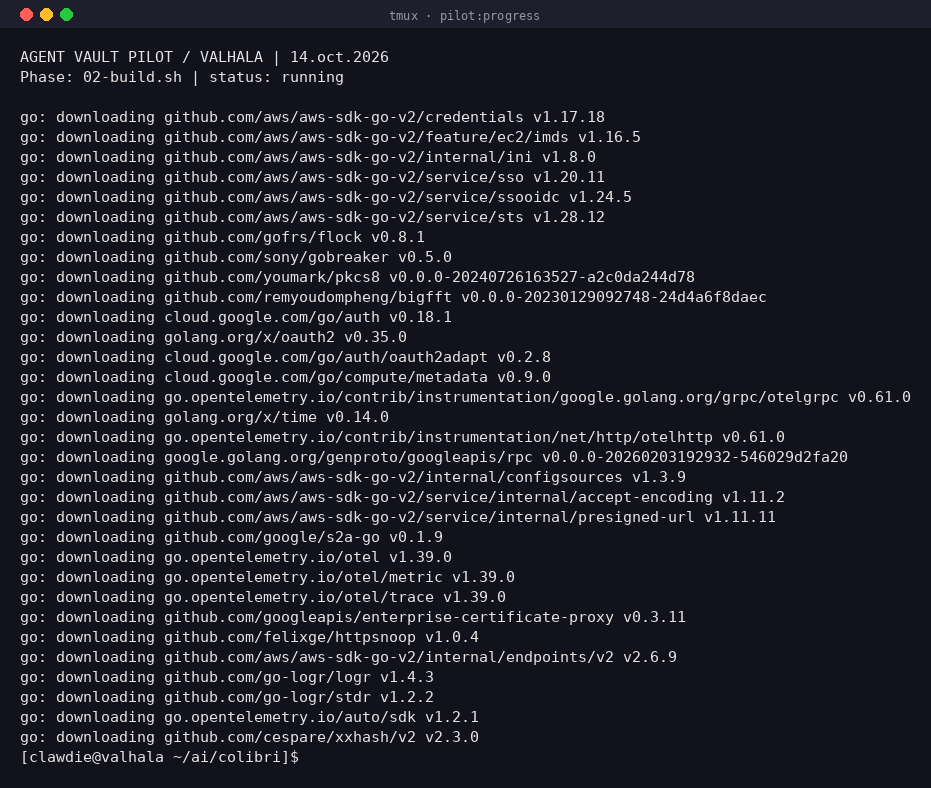
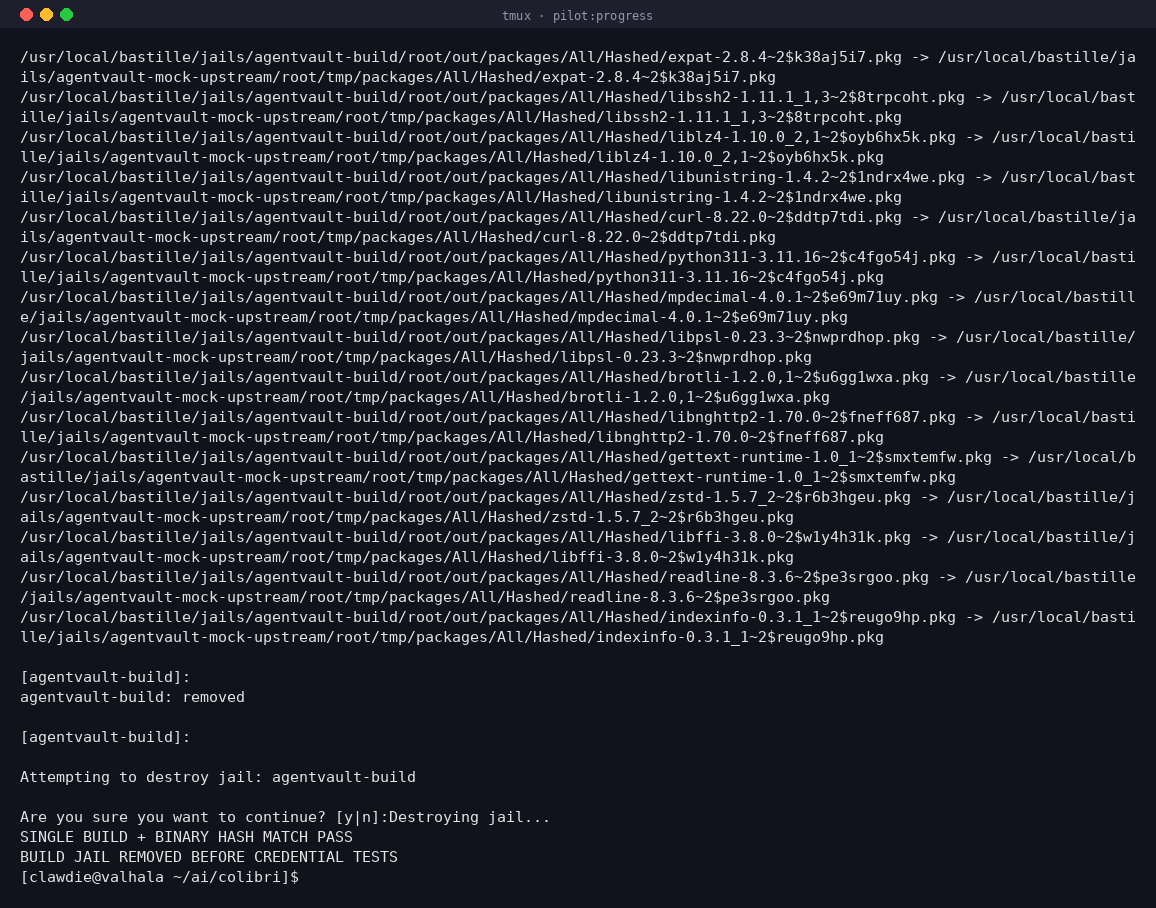
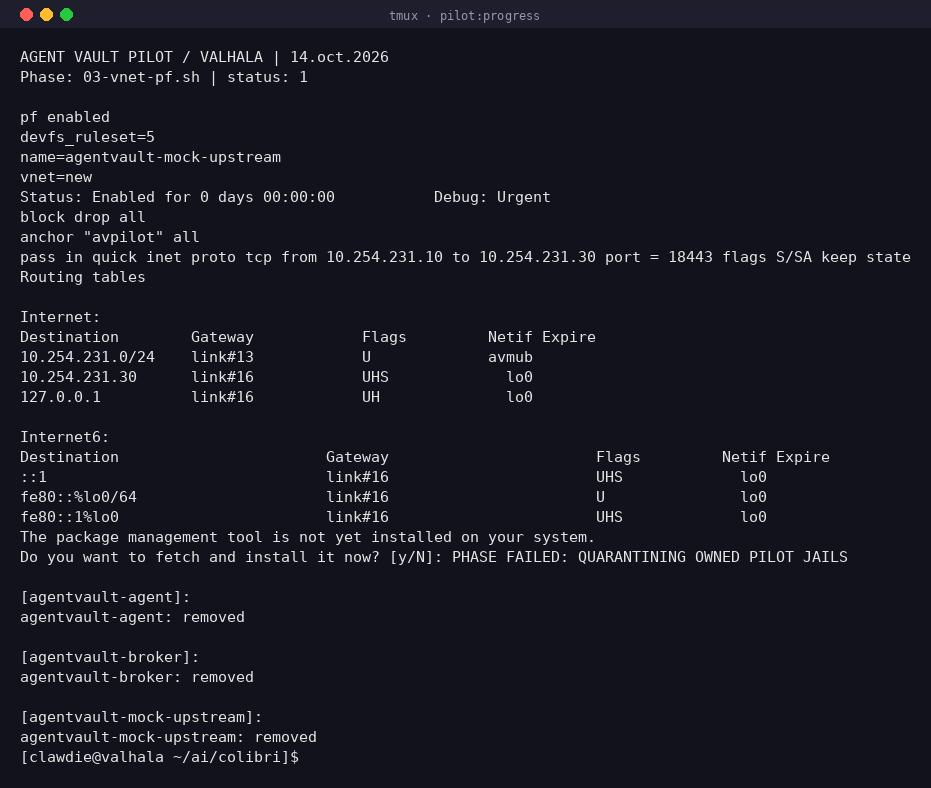
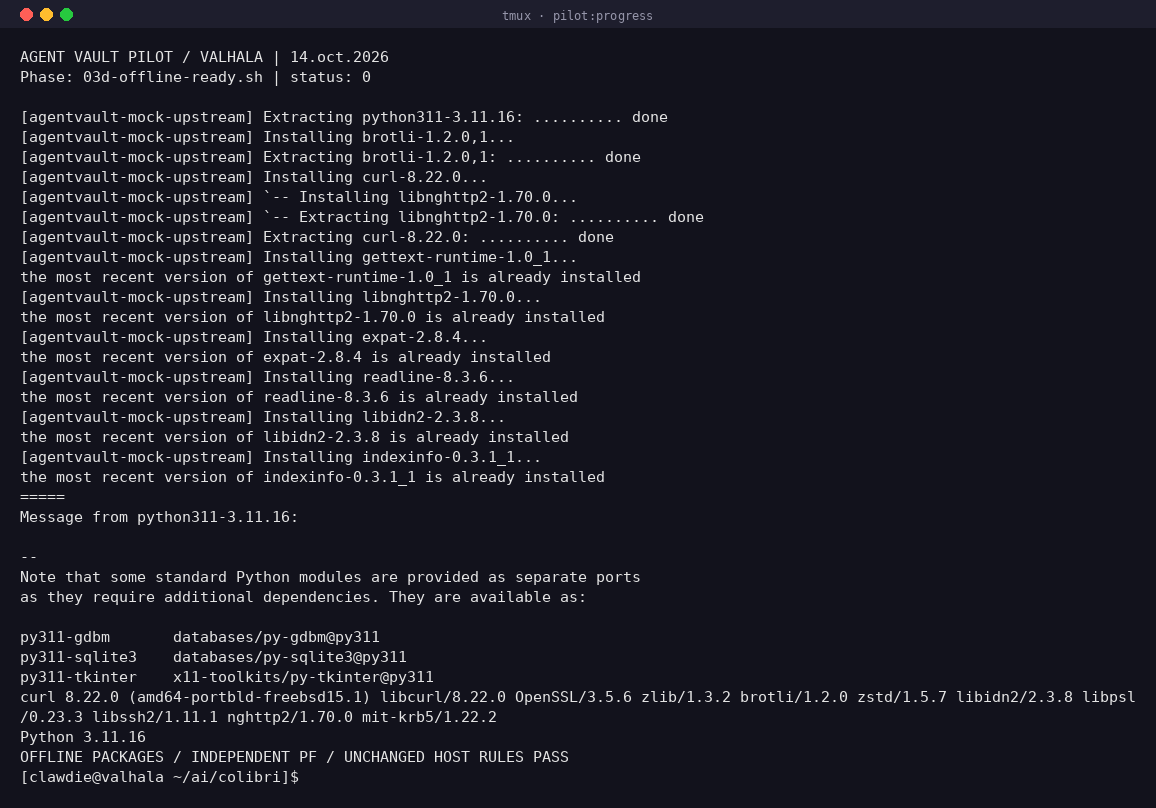
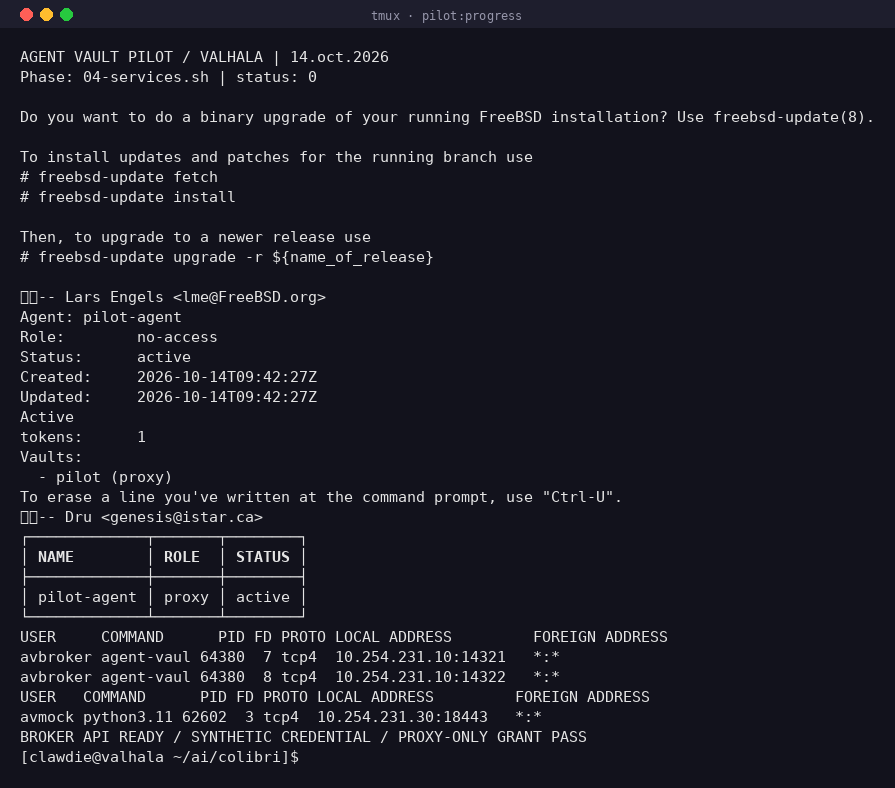
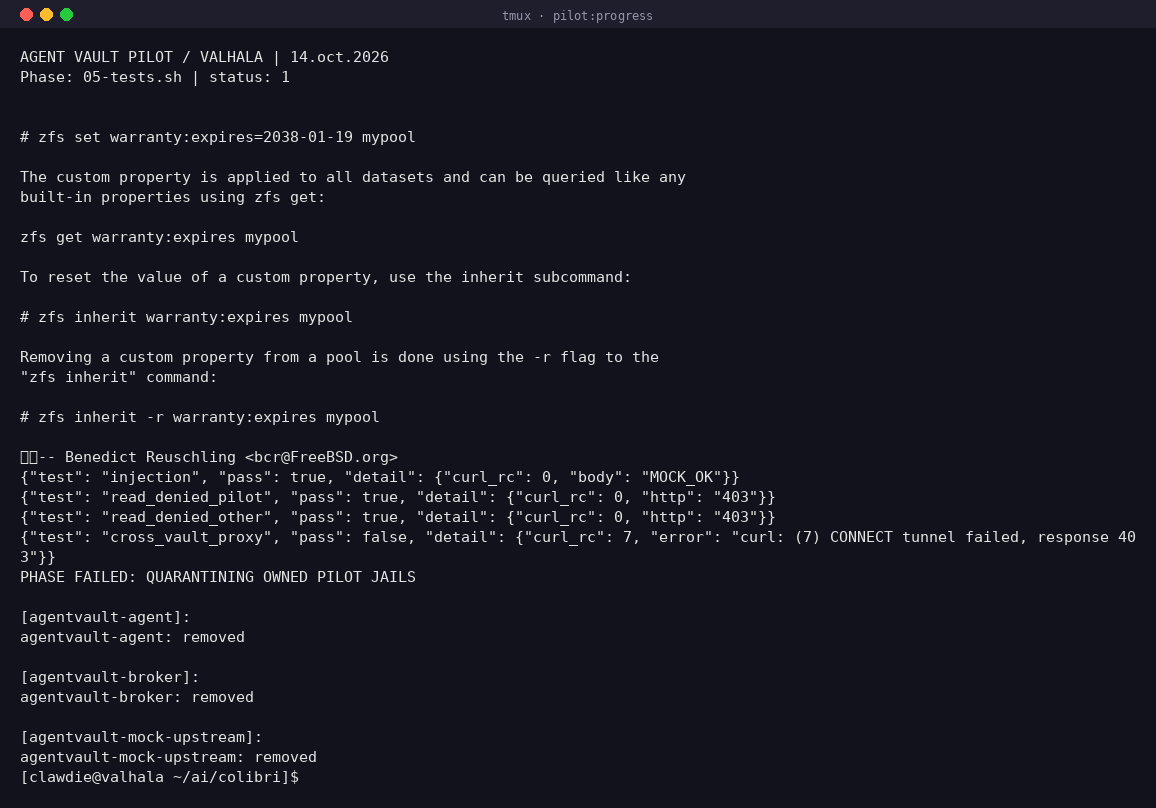
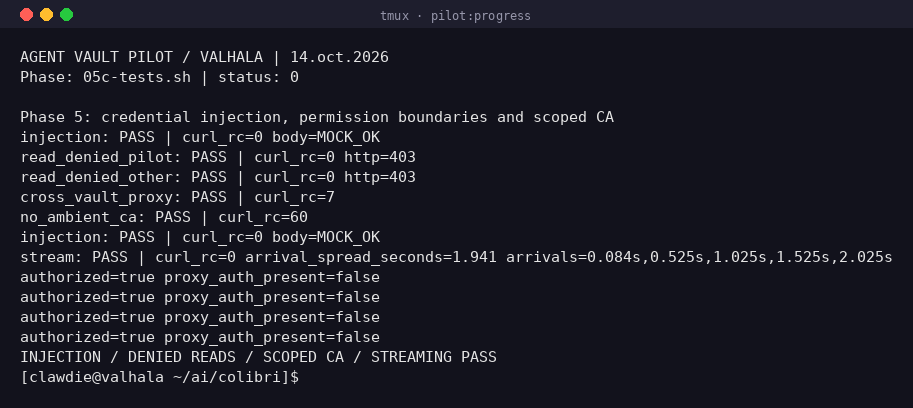
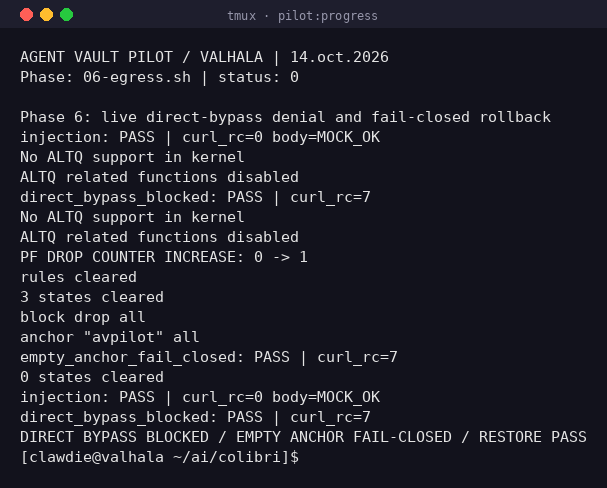
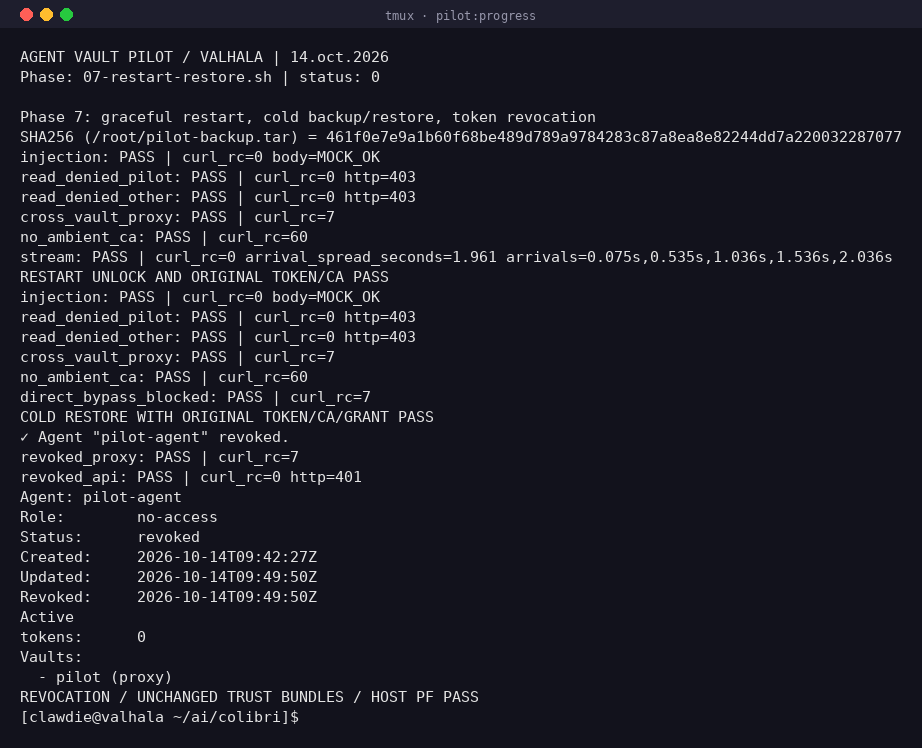
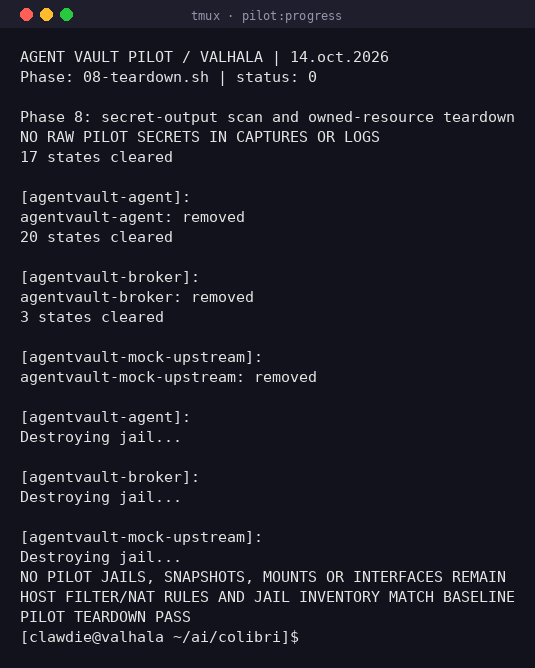
The result verifies this disposable mock pilot. Real provider or agent-harness integration, production adoption, public UI access, unattended boot and PXE/USB hardware acceptance remain separate work.
Follow-up: observed DeepSeek usage
Section titled “Follow-up: observed DeepSeek usage”Today I also added a cost baseline. My screenshot of the DeepSeek Usage dashboard, supplied on 14.oct.2026, has Last 30 days and All API keys selected. The displayed time zone is GMT+2.
- Cost for the selected period: USD 20.45.
- API requests: 8,975.
- Displayed token total: 1,586,906,914.
- Separate account-summary figure labelled “Total cost”: USD 93.21.
- Remaining “Topped-up balance”: USD 11.78.
I use USD 20.45 for the 30-day spend. USD 93.21 and USD 11.78 are separate account-summary figures and are not added to that period’s cost.
This is usage on my account, not a measured cost per pilot customer. The screenshot does not break down models, input versus output tokens, cache hits, or usage by customer. It also does not show Jev, hosting, or support costs. It therefore does not establish the paid pilot’s profitability.
For a bring-your-own-key (BYOK) pilot, customers remain responsible for their model-provider charges. I record this figure as a baseline for tracking actual usage as more evidence arrives.
Follow-up: TypeSafe AI / Jev usage
Section titled “Follow-up: TypeSafe AI / Jev usage”The next screenshot, also supplied on 14.oct.2026, shows TypeSafe AI Usage for Jev. All traffic, Last 30 days, and the daily view are selected. The dashboard notes that statistics may be delayed.
- Displayed estimated “Spend*”: USD 0.0308.
- Displayed token total: 888,361.
- Requests: 560.
- Input tokens in the separate breakdown: debby 731,122, valhala 2,206.
- Remaining account balance: USD 8.97.
The screenshot’s footnote says the estimate uses USD 0.042 per million input tokens, with free output tokens in this view. The two input figures total 733,328 tokens; at that stated rate, the result is approximately USD 0.0308, matching the displayed estimate. I therefore do not label the overall 888,361-token figure as input tokens.
This is a dashboard estimate, not a verified invoice or a guaranteed future rate. The balance is not spending for the period. The 560 requests are also not a measured workload for ten pilot customers. I record TypeSafe separately from DeepSeek as a baseline for the Jev decision layer; hosting and support still need their own evidence.
Follow-up: Plone and two roles for secret storage
Section titled “Follow-up: Plone and two roles for secret storage”The Plone Web-UI design now considers two complementary roles: Tarsnap for encrypted backups and disaster recovery, and 1Password or Vaultwarden for active credential access. Plone commit 5d33115 contains the plan and a provider-selector prototype. It does not yet prove configured storage or successful recovery.
Independent review found that one selector mixes these roles. Selecting an active vault must not remove the backup path. An isolated test using a fake client also found two defects: an Agent Vault 503 response still produced success and a RUNNING profile, and form input could override the custodian identity admin_ident. The selector currently changes metadata; it does not configure Tarsnap, 1Password, or Vaultwarden integrations.
Before operational use, we need separate roles, a custodian identity resolved on the trusted server side, and success reported only after verified results. We also need a backup-restore test and a correct distinction between 1Password service-account authentication and Connect authentication. Syntax and secret checks pass; they do not establish working enrollment or recovery.