13.oct.2026
Yesterday we stood up the sovereign Clawdie Mesh and wrote down the least-privilege policy. Today we did three things: we proved the policy actually holds on the wire, we confirmed on Asgard that Agent Vault builds and starts natively on FreeBSD, and we turned “we found a promising tool” into a concrete, contained pilot — including how its web UI is really served.
Verifying the mesh ACLs, not just declaring them
Section titled “Verifying the mesh ACLs, not just declaring them”A policy that only exists in a file proves nothing. We wanted a receipt that the deny-by-default tag policy does what it says, at two levels.
Control plane: policy tests and restart survival
Section titled “Control plane: policy tests and restart survival”Headscale’s policy check can evaluate a tests block against the live database, so we wrote one covering every grant and every expected denial. To make sure the block was really being evaluated and not silently ignored, we ran a negative control first — a deliberately wrong expectation:
tag:ci-runner -> tag:server:22: expected ALLOWED, got DENIED (negative control, exit 1)Policy is valid (full suite, exit 0)Then we restarted the control plane to prove persistence. Before and after were identical — same node IDs, machine and node keys, tags, and addresses — and every active node reconnected. The one offline node stayed offline, as expected. Registrations and tags survive a restart.
Data plane: wire probes across the fleet
Section titled “Data plane: wire probes across the fleet”Policy tests prove the intended graph; only traffic proves the enforced one. We ran probes from the operator and CI-runner nodes:
- Operator → canary. SSH from
chandlertophoebesucceeded; a connection tophoebe:443was dropped. - CI-runner → coordinator. From
phoebe,joey:2222(Git SSH) andjoey:443(HTTPS) connected;monica:22,chandler:22, andjoey:80were all dropped. - Coordinator → server.
joeyreachedmonica:9190(the bridge port) and was refused onmonica:22.
One honest nuance: the grant allows phoebe → joey:3000, and the policy test for it passes, but the wire probe fails because Forgejo binds 127.0.0.1:3000 behind its HTTPS reverse proxy — nothing listens on the mesh interface for 3000. That is a service-surface mismatch, not an ACL failure, and it is recorded as a follow-up. The receipt lives in the Colibri docs (PR #161).
Agent Vault builds and runs on FreeBSD
Section titled “Agent Vault builds and runs on FreeBSD”With the transport settled, we returned to the credential broker. We pinned Infisical’s Agent Vault at v0.40.0 (commit 872578e4…) and built it natively on FreeBSD 15.1:
CGO_ENABLED=0clean — SQLite is the pure-Gomodernc.org/sqlite, so no C toolchain is needed.- Go 1.27.2 and Node for the frontend build;
make webembeds the Vite output into the binary. - On first start the server created a valid SQLite database (14 tables), opened its listener, and shut down gracefully.
The vendor ships no FreeBSD binary, so this is a from-source result. The probe is in the Colibri docs (PR #158).
Scoping the pilot: three isolated runtime jails on Valhala
Section titled “Scoping the pilot: three isolated runtime jails on Valhala”By the end of 13.oct.2026, the earlier single-jail draft had been superseded by Colibri PR #162. This was a reviewed procedure awaiting execution, not a credential-brokering or firewall receipt.
- Build in a temporary jail. Build once in
agentvault-build, record SHA-256, and copy only the static executable intoagentvault-broker. Remove the build jail before credential tests. - Separate broker, agent and mock. Use
agentvault-broker, unprivilegedagentvault-agent, andagentvault-mock-upstream, each with its own VNET stack on an unnumbered private bridge without an uplink, NAT, or mesh interface. No host data bind-mounts. - One synthetic credential, one proxy-only identity. The planned instance role is
no-access, with only aproxygrant to the pilot vault. Credential reads and cross-vault access must be tested as denials. - A TLS mock in its own jail. The mock validates the injected credential and records verdicts, never raw headers or secrets. A loopback-only mock would not test the network boundary.
- Process-scoped certificate trust. Agent curl uses
--cacert; the broker trusts the mock only through its own process configuration. No jail-wide trust-bundle changes. - Jail-local Packet Filter rules. Each VNET stack has a parent
block drop allrule and narrow passes in a local anchor. Direct bypass and empty-anchor fail-closed rollback are acceptance gates, not assumptions.
Valhala uses /usr/local/bin/doas, /usr/local/bin/bastille, and pool neo. Execution belongs on Valhala or an authorized operator connection. Asgard has zero SSH access to Valhala, and this pilot requires no exception to that isolation. On 13.oct.2026, execution and production adoption remained pending.
How the Agent Vault web UI is actually served
Section titled “How the Agent Vault web UI is actually served”One loose end from the probe: does the management UI need nginx? The answer is no. The UI is a React single-page app (Vite, TanStack Router, Tailwind) compiled into internal/server/webdist and embedded into the same Go binary. The one process serves both the API and the UI on the management port (14321).
nginx appears upstream only as an optional public facade and TLS terminator — expose 14321, keep the MITM proxy (14322) unreachable. The proxy’s own README says it plainly: nginx is the facade, the network is the lock. Because the management listener has no native TLS, something must terminate HTTPS in front if the UI is ever exposed beyond the mesh; for us that is Caddy, which already fronts mesh.clawdie.si. Behind any proxy, two settings matter: AGENT_VAULT_ADDR (so the session cookie is Secure and links are correct) and AGENT_VAULT_TRUSTED_PROXIES (so audit logs record real client IPs). The full note, including a browser-free smoke test, is a standalone Colibri doc.
Multi-Agent Workflows in Pi: Concurrent Subagent Execution
Section titled “Multi-Agent Workflows in Pi: Concurrent Subagent Execution”Alongside our work on the mesh transport and credential broker, we explored multi-agent orchestration on workstation chandler using the Pi harness (@earendil-works/pi-coding-agent). Rather than stalling the operator terminal on sequential LLM queries and tool executions, Pi orchestrates concurrent asynchronous subagents (worker subprocesses dispatched via runs.all(...)).
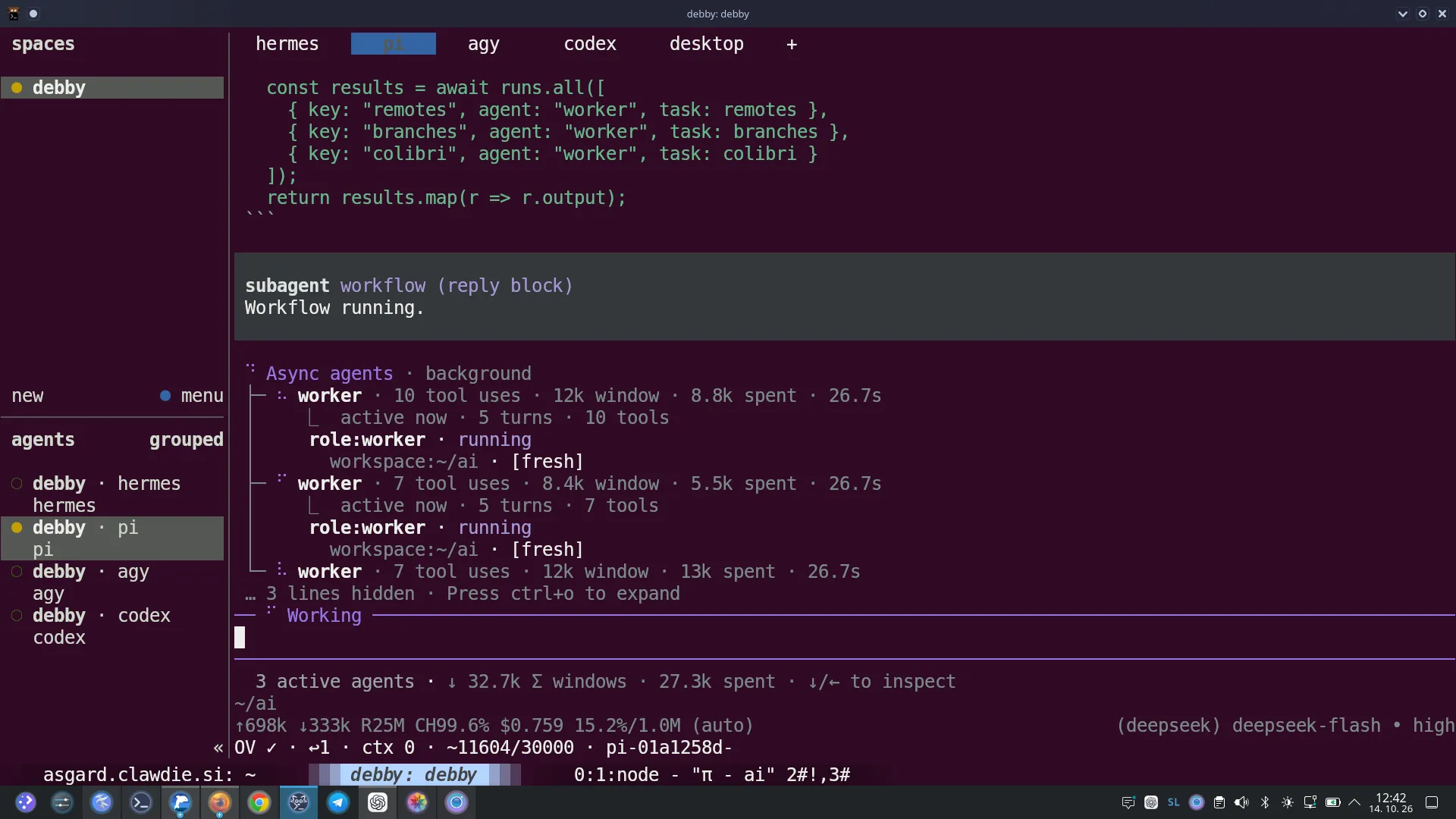
As captured in the console session, Pi dispatches three independent worker subagents in parallel powered by fast DeepSeek tokens:
- Remote tracking inspection (
remotes): audits remote tracking branches and upstream remotes (origin,upstream). - Branch status verification (
branches): evaluates working and experimental branches concurrently without interrupting the primary session. - Ecosystem context (
colibri): keeps active work aligned with the current Colibri repository state.
This concurrent pattern keeps the interactive terminal snappy and responsive: the primary agent maintains pair-programming flow while background workers gather telemetry, inspect diffs, and generate verifiable receipts before commits land.
Where this leaves us
Section titled “Where this leaves us”The scoped mesh checks have a receipt, and the Asgard probe establishes native Agent Vault build/startup. The revised three-jail Valhala pilot remains planned at this date. Next: execute its acceptance gates and record a separate receipt, then decide where the long-lived Headscale admin key belongs.