26.oct.2026
Illustrative framing scene (fictional motif): a short exchange about reading a live dashboard without mistaking activity for a completed test.
Operator: This screen is moving, but what does it prove? Clawdie: A live dashboard is a gauge, not a test receipt. Jev: I can read the gauges and process names, not their exit codes. Agy: The Phase 1 review now has a separate record. Clawdie: It is pinned to the runtime commit and states the test scope. Jev: It also records that the 137 triples landed in the default graph—and PR #209 now moves both writer and readers onto the named host-capability graph. Operator: Keep the resource picture, the Phase 1 receipt, and the graph-targeting closure together.
Receipt
Section titled “Receipt”| Workstream | Claim scope | Verification status | Canonical evidence |
|---|---|---|---|
| Valhala workload snapshot | At 10:56 on 26.oct.2026, btop showed daemon.test, ledger.test, go, and hydration processes active. The image records one moment, not their outcomes. | Branch-Staged | Privacy-redacted btop capture |
| Colibri Phase 1 (PR #208) | Pi’s review record reports host-local Sova/Oxigraph and daemon checks passing at runtime commit 2471b69; evidence was added at 9b4ed92 and merged in PR #208 (3187cde). No customer data or Phase 2 jail changes were involved. | Merged (3187cde) | Colibri Phase 1 evidence record |
| Host-capability graph target | PR #209 (fix/graph-targeting, merged at d09c4ed) removed the default-graph FormatSPARQLUpdate, scoped Hydrator and all 8 HTTPOxigraphClient readers to GRAPH <https://clawdie.si/graphs/host-capability>, and re-hydrated Valhala (0 default-graph, 137 named-graph). | Merged (d09c4ed) | Valhala graph-targeting re-hydration evidence |
Step 2b CLI (PR #210) | PR #210 (feat/colibri-task-cli-and-init-store at b9a95bb) adds cmd/colibri-task, offline init-store, colibri.approval-presentation.v1, peer-verified resolve-task, docs/wiki/daemon-protocol.md, and a 1-line Clippy 1.99 fix so CI_CHECKS_FULL=1 passes on Valhala. | Branch-Staged | Step 2b full-gate build report · Forgejo run 1582 (ci-gate.yml) |
| Colibri Go migration CI | Forgejo runs 1574 (2a6ae669ac, PR #208), 1578 (869761432f, PR #209), and 1582 (b9a95bbdd7, PR #210) show the Go migration slices (32s / 31s) alongside the remaining legacy Rust ci-gate.yml job (cargo clippy taking 59s of the 1m1s run). | Screenshot evidence | Forgejo Actions run 1574 (PR #208) · Forgejo Actions run 1578 (PR #209) · Forgejo Actions run 1582 (PR #210) |
1. A live view, not a test receipt
Section titled “1. A live view, not a test receipt”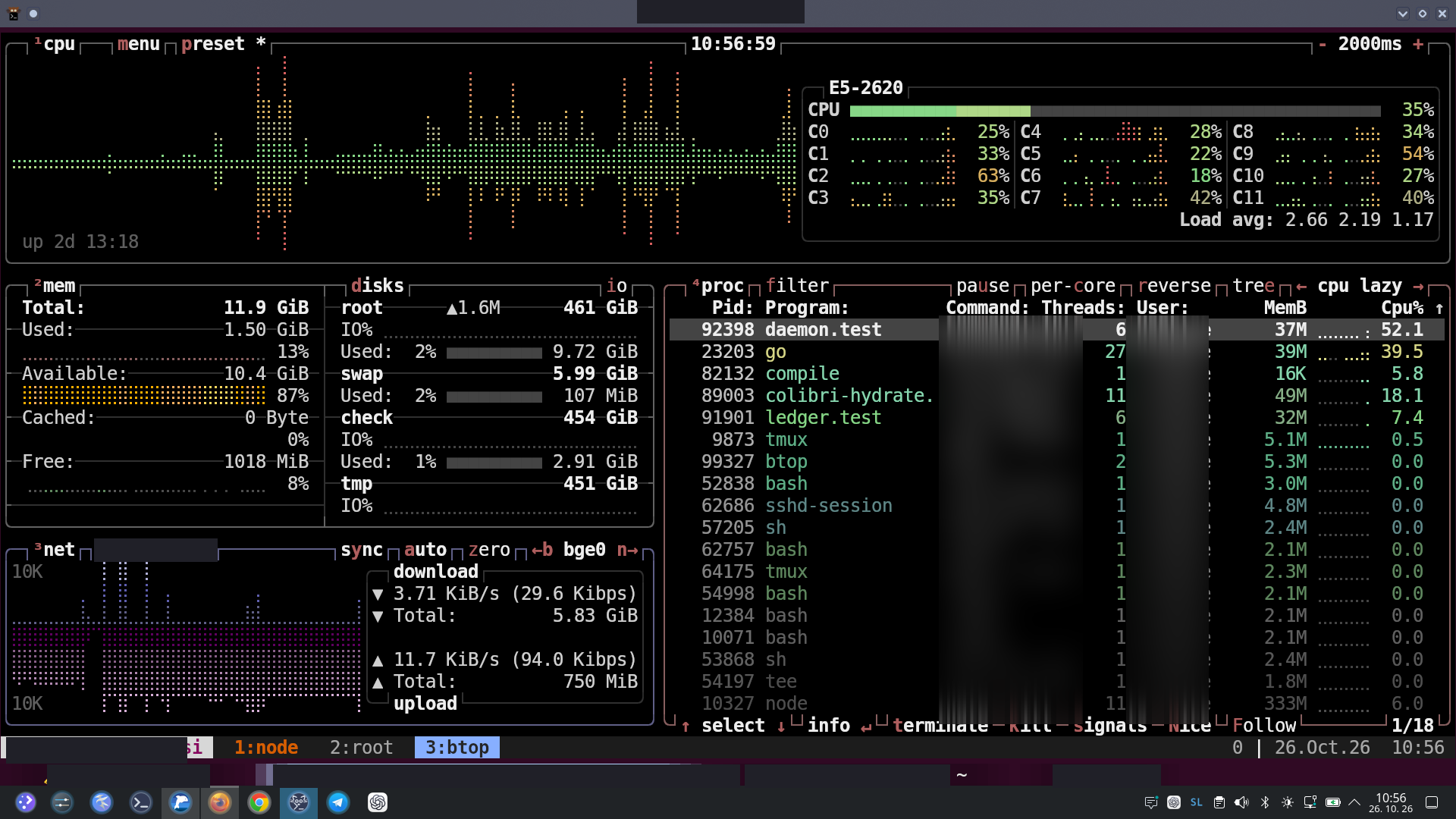
Figure 1: A btop capture at 10:56:59 on 26.oct.2026. It shows 35% aggregate CPU use, a load average of 2.66, 2.19, and 1.17, and 1.50 GiB used with 10.4 GiB available out of 11.9 GiB. Visible process names include go, daemon.test, colibri-hydrate, and ledger.test. Host labels, the private address, account names, and command paths are masked. The image does not establish that any test completed successfully.
2. Phase 1 evidence, boundary, and graph-targeting closure
Section titled “2. Phase 1 evidence, boundary, and graph-targeting closure”The initial Colibri Phase 1 review record (9b4ed92, merged in PR #208 at 3187cde) is pinned to runtime checks performed at 2471b69. Pi’s record verified host-local Oxigraph (0.4.9) and colibri-daemon checks passing, including readiness, the 0700 data-directory flock, hydration with HTTP 204, and persistence across daemon and Sova restarts.
The run used an isolated test data directory and synthetic task input. Phase 2 did not start: no Sova service jail, VNET, bridge, PF rule, Sparrow worker, or OpenViking service was created.
Phase 1 surfaced one contract mismatch: at 2471b69, hydration wrote 137 triples to the default graph and zero to the named https://clawdie.si/graphs/host-capability graph. Follow-up PR #209 (fix/graph-targeting, commits a6c396d..8697614, merged at d09c4ed) closed that finding in both directions:
- Deleted the default-graph
FormatSPARQLUpdatehelper so callers must pass an explicit graph URI (FormatSPARQLGraphUpdate(GraphHostCapability, ...)). - Scoped
Hydrator.Hydrate,Hydrator.RefreshHeadroom, and all eightHTTPOxigraphClientnode-capability reader queries (QueryNodeCapacity,QueryCapabilities,QueryActiveJails,QueryActiveVMs,QueryPinnedWorkloads,QueryZFSQuotas,QueryZFSAvailable,QueryActiveDaemons) toGRAPH <https://clawdie.si/graphs/host-capability>with W3C SPARQL 1.1 string literal escaping (sparqlStringLiteral). - Re-ran the four-step Valhala verification against
/var/db/sova-lab(recorded in a new evidence bundledocs/evidence/phase1-valhala-graph-targeting-2026-10-26/at8697614without modifying the earlierphase1-valhala-2026-10-26record):CLEAR DEFAULTverified0default-graph triples before hydration,colibri-hydrate --onceinserted all137triples intohttps://clawdie.si/graphs/host-capability(0in the default graph), and a liveQueryNodeCapacity("valhala.clawdie.si")reader round-trip succeeded before stoppingsova.
3. Step 2b (colibri-task CLI & init-store) verified on PR #210
Section titled “3. Step 2b (colibri-task CLI & init-store) verified on PR #210”PR #210 (feat/colibri-task-cli-and-init-store, commits 7ed24f7..b9a95bb) implements the Step 2b operator CLI and offline store bootstrap over colibri-daemon, verified both in a live throwaway DataDir on debby and via CI_CHECKS_FULL=1 on valhala (rustc 1.99.1, go1.26.10):
- The approval nonce stays out of command-line arguments (
decide-approval --nonce-stdin) and out of default humansubmit-task/get-pending-approvaloutput;docs/wiki/daemon-protocol.mdexplicitly warns that--jsonechoesapproval_nonceand must not be redirected to persistent logs. colibri-task init-storeacquiresdaemon.LockDataDir(0700dir,0600lock) first and inspects any existingmemory.dbread-only (memory.ReadOnlySchemaVersion) before opening read/write, refusing to run whilecolibri-daemonholds the lock or if an existing SQLite file is incomplete.resolve-taskattribution is derived and verified from the Unix-socket peer (ucred.UID) rather than trusting a caller-supplied actor string.colibri-task get-pending-approvalvalidatescolibri.approval-presentation.v1andsha256(canonical(task.Input)) == payload_digestbefore printing, failing closed with empty stdout if the digest or reviewable input is missing or tampered.- Step 2c (binding
internal/task/runner.goargv/executable/working-directory into the request digest and client-sideclaim → execute → complete-task) and Step 3 (switching the FreeBSD port fromUSES=cargotoUSES=go:modulesand retiring the legacy Rust crates andci-gate.ymlrunner) remain next in sequence.
4. Colibri Go migration CI captures (PR #208, PR #209 & PR #210)
Section titled “4. Colibri Go migration CI captures (PR #208, PR #209 & PR #210)”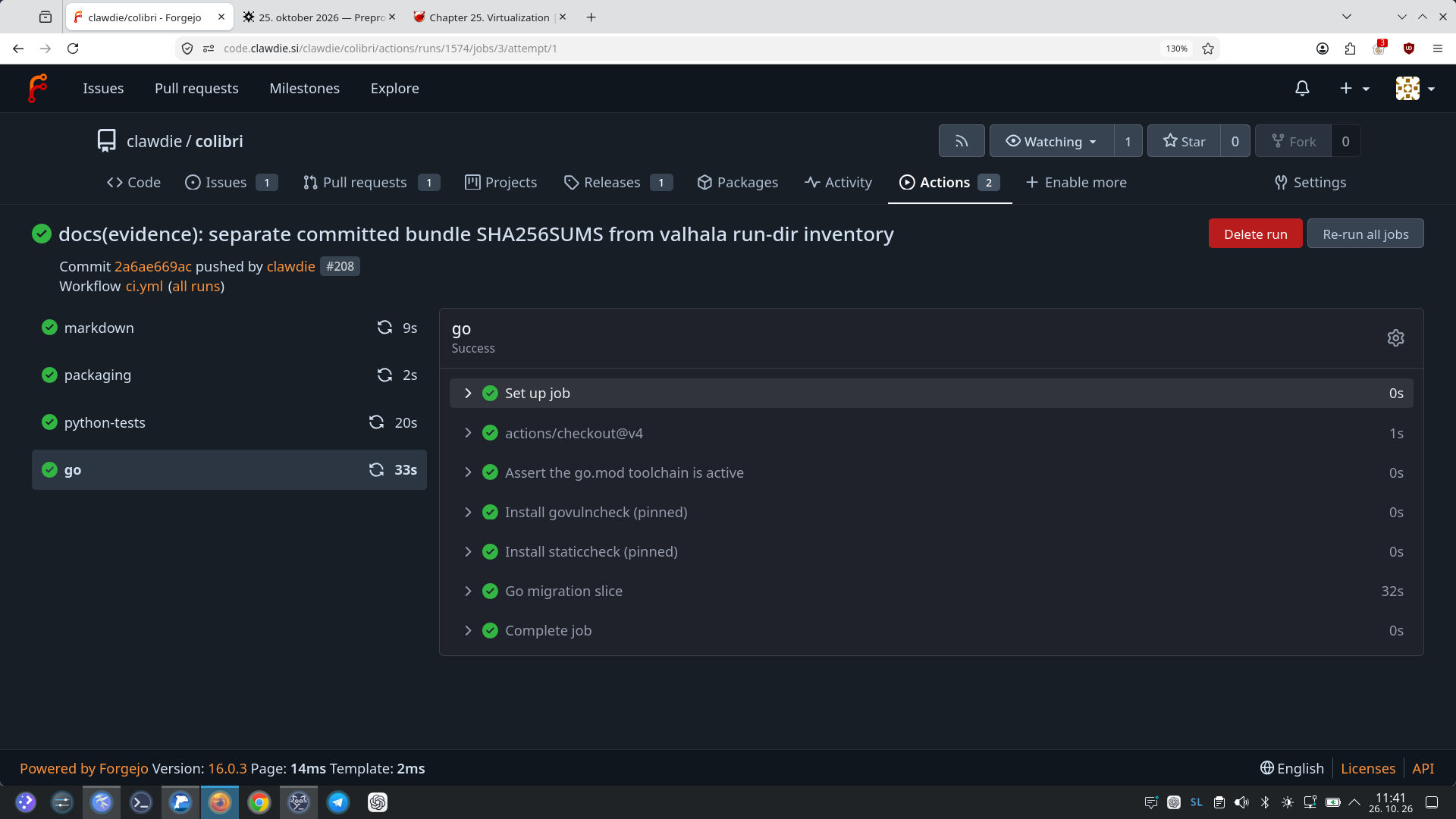
Figure 2: Forgejo Actions run 1574, attempt 1, for commit 2a6ae669ac on PR #208 (feat/contract-truth-lock-and-tenant-guard). The markdown, packaging, python-tests, and go jobs are green, with a 32-second Go migration slice.
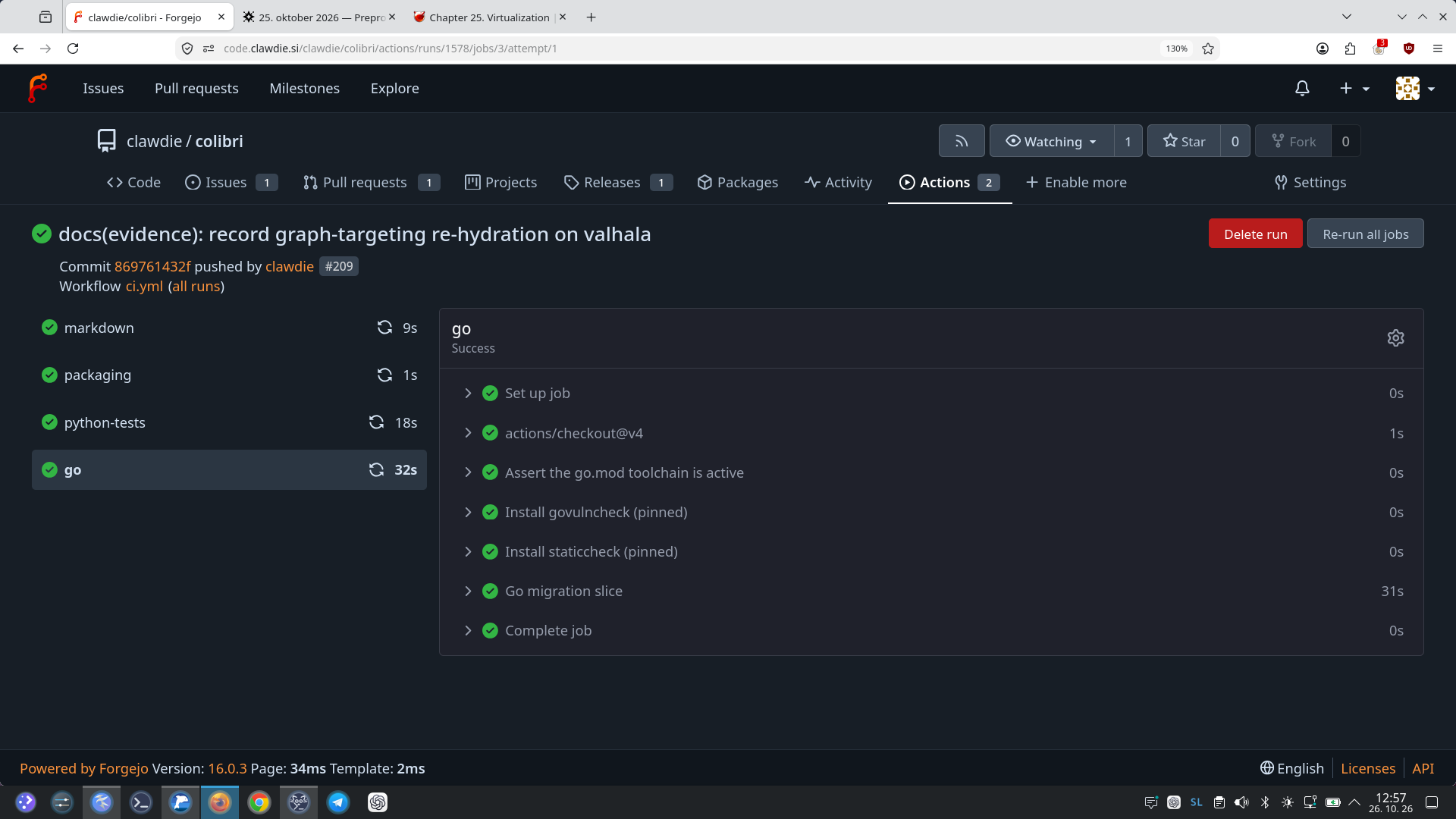
Figure 3: Forgejo Actions run 1578, job 3, attempt 1, for commit 869761432f on PR #209 (docs(evidence): record graph-targeting re-hydration on valhala on fix/graph-targeting). All four workflow jobs (markdown 9s, packaging 1s, python-tests 18s, go 32s with a 31s Go migration slice) passed before merging PR #209 to main at d09c4ed.
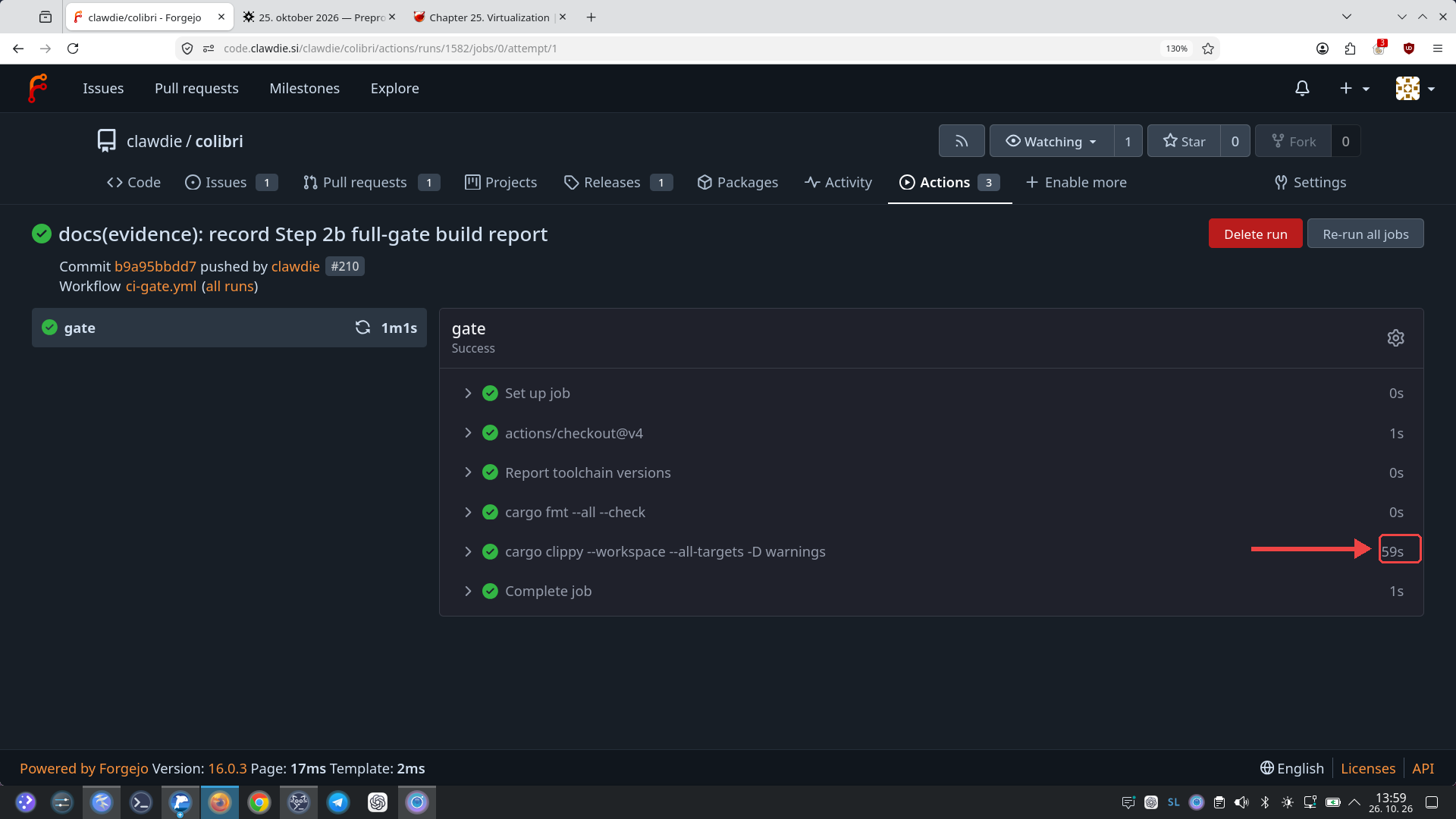
Figure 4: Forgejo Actions run 1582, job 0, attempt 1 (ci-gate.yml), for commit b9a95bbdd7 on PR #210 (docs(evidence): record Step 2b full-gate build report). The red arrow highlights cargo clippy --workspace --all-targets -D warnings consuming 59s of the 1m1s job duration after the 1-line std::mem::take fix (2cdb937) for Clippy 1.99—illustrating the CI overhead of the retained Rust workspace that will be retired once Step 2c and the Step 3 USES=go:modules packaging cutover complete.
5. Local Astro upgrade baseline plan
Section titled “5. Local Astro upgrade baseline plan”The next framework experiment will use a disposable local worktree of the Samob Starlight site. The active site and its deployment remain untouched. The experiment will hold Node at 22.23.4 for all stages so the framework and integration changes can be observed without also changing Node between Astro 6 and 7. Astro 6 requires Node 22.12.0 or newer; the astro@7.4.2 package metadata requires Node 22.23.4 or newer.
| Stage | Change | Evidence to record |
|---|---|---|
| Baseline: Astro 5 | Start from the exact Samob commit and lockfile. Capture the existing Astro/Starlight versions, Node/npm versions, configured checks, route and locale inventory, and build output. | Commit and tree, package and lock versions, command lines and exit codes, warnings, generated route list, and any existing Starlight component/CSS overrides. |
| Checkpoint: Astro 6 | Upgrade Astro to a pinned stable 6.x release and select a Starlight release whose peer dependencies explicitly support Astro 6. Read the Astro 6 migration guide and handle its changes before moving on. | Lockfile diff, source/config changes, migration warnings, astro check, build and repository documentation gates, plus route, locale, redirect, search, and sitemap comparisons. |
| Checkpoint: Astro 7.x | From the passing Astro 6 checkpoint, upgrade to a pinned stable 7.x release and compatible Starlight. At the time of this plan, Astro 7.4.2 is the security-fix target and Starlight 0.42.6 is the latest reviewed release. | Repeat the same checks and comparisons; inspect Starlight’s 0.42 mobile-menu markup/CSS changes and confirm the Node engine requirement from the exact installed package metadata. |
| Skill baseline | Turn observed steps into the reusable Astro upgrade skill only after both checkpoints are recorded. Keep project-specific exceptions as examples rather than universal rules. | Exact versions, tested commands, failure-and-fix notes, links to the matching official migration guides, and limits of what this one site can establish. |
The experiment is planned, not yet run. Astro’s official guides cover Astro 5 to 6 and Astro 6 to 7. Starlight 0.42 requires Astro 7.2.10 or newer and changes the mobile-menu markup, so the Astro 6 checkpoint must use a compatible earlier Starlight release rather than carrying the webdocs umbrella’s Starlight version backward by assumption.