Workshop Circuit: Moving Across the Memory Stations
Rather than static desks, the scene navigates from table to table. Each station introduces an accessible visual card ("Simple Joe" language) that contributes to assembling the verified memory layer.
01Verified · PR #186
Durable Memory & Record
The Ledger Worktable
Carrier Pigeon (Golob)
Simple Joe Experience
The physical worktable where every verified fact is stamped into the ledger. Once recorded here, nothing is altered or forgotten.
Technical Backing
Canonical SQLite authority (memory.db) · Pure-Go v1 schema with conflict preservation and strict tenant boundaries.
↓
02Fail-Closed Active
Fail-Closed Gatekeeper
The Inspection Gate
Peacock (Rajska ptica)
Simple Joe Experience
A strict checkpoint before the workshop floor. Bold and creative proposals are inspected here; only authorized actions pass.
Technical Backing
Deterministic policy gates with Jev advisory semantic pre-screen. AI classifiers can raise scrutiny but never grant authority.
↓
0328 Checks Green
Live Telemetry & Neural Bridge
Nadzorna Konzola (Console)
Colibri
Simple Joe Experience
The primary terminal screen presented to the operator. Streams real-time test runs, telemetry, and live execution evidence.
Technical Backing
Continuous test telemetry, TypeSafe System One Jev 1.14 integration, and passive Go daemon monitoring.
↓
04Dual-Graph Verified
Compiler Intake Receipt
Ceiling Projector & Receipt
Clawdie
Simple Joe Experience
The overhead synthesis beam that collects cards from the tables and projects the complete, live memory layer onto the workshop ceiling.
Technical Backing
Oxigraph dual-graph SPARQL projection bridge · Atomic live state derived from SQLite without state pollution.
Today marked the completion of the core memory architecture milestone for Colibri. The memory subsystem now enforces the strict blueprint invariant: SQLite (memory.db) is the canonical system of record, while the Oxigraph quad store is strictly a derived, rebuildable live-state projection.
Both halves of this architecture were developed in parallel across the mesh, reconciled through multi-pass peer review between Asgard (FreeBSD) and Debby (Linux), and verified clean in continuous integration.
Pi on Asgard implemented the canonical SQLite storage engine (internal/memory/store_sqlite.go) using pure-Go modernc.org/sqlite without CGO, ensuring static binaries on FreeBSD:
Divergent write preservation: Divergent writes to an existing (tenant, id) are preserved as deterministic conflict records rather than clobbering the incumbent.
Eliminated wildcard deletion: Replaced DELETE { ?node ?p ?o } with targeted deletion of owned node predicates and provenance triples (colibri:sourceRef, colibri:contentHash, colibri:derivationMethod), ensuring independent watchdog observations survive hydration ticks.
Atomic fresh-store rebuild: Formatted rebuilds into a single multi-operation SPARQL Update transaction using DROP SILENT GRAPH ... ; INSERT DATA { ... }. If an operation fails, Oxigraph rolls back without leaving cleared or corrupted graphs.
FreeBSD testing on Valhala and independent review passes closed two subtle security and consistency gaps:
Order-independent duplicate admission: All placeholder records are now security-scanned and validated prior to deduplication. Differing metadata between records for the same key marks them as conflicting evidence, preventing slice ordering from hiding poisoned credentials.
Diagnostic secret non-reflection: Non-acquired states are checked against an allowlist of canonical states (isKnownPlaceholderState). Unverified or synthetic secret tokens in state fields are caught and sanitized to (invalid state) or (invalid evidence), ensuring no rejected secret bytes leak into diagnostic logs.
Bare vault rejection: Bare vault:// or vault:/// references without a specific path are strictly rejected.
With canonical storage and projection verified, we are ready to advance to Step 3: the pure Go control plane (cmd/colibri-daemon), beginning the controlled retirement of the frozen Rust crates.
Together, the agents drafted, reviewed, and finalized the Release 0.15 State Contract (docs/plans/RELEASE-0.15-STATE-CONTRACT.md @ commit be40eb3 / PR #189), establishing clear rules for:
Four-axis lifecycle & build alignment:release_state, alignment_state, customer_state, and migration_phase.
Preserved historical alignment: Deprecation is treated as a lifecycle transition rather than an evidential defect; superseded artifacts retain valid alignment.
Telemetry contradiction preservation: CI can record newly detected telemetry contradictions on customer-facing artifacts without deadlocking on operator-only recall actions.
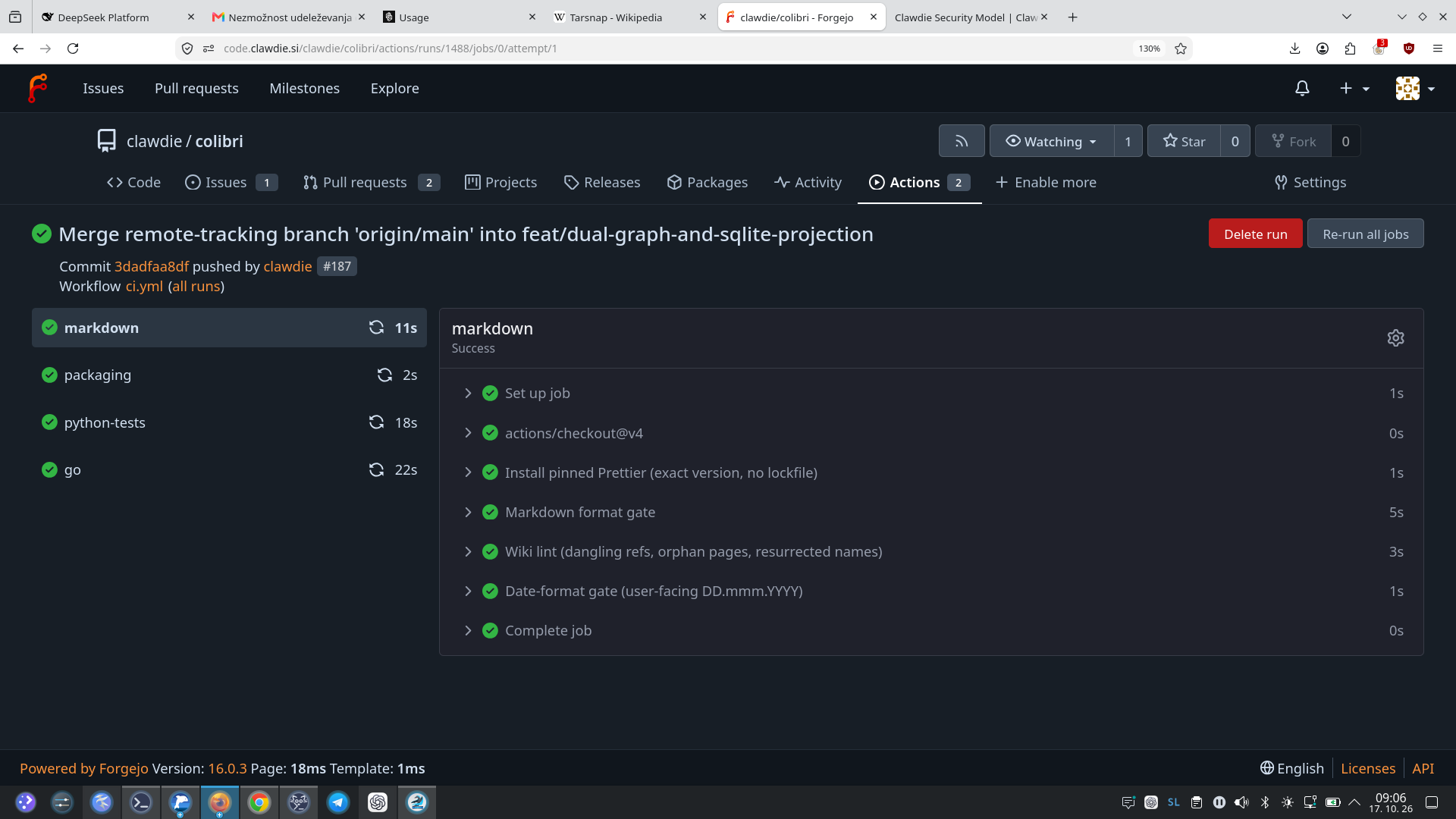
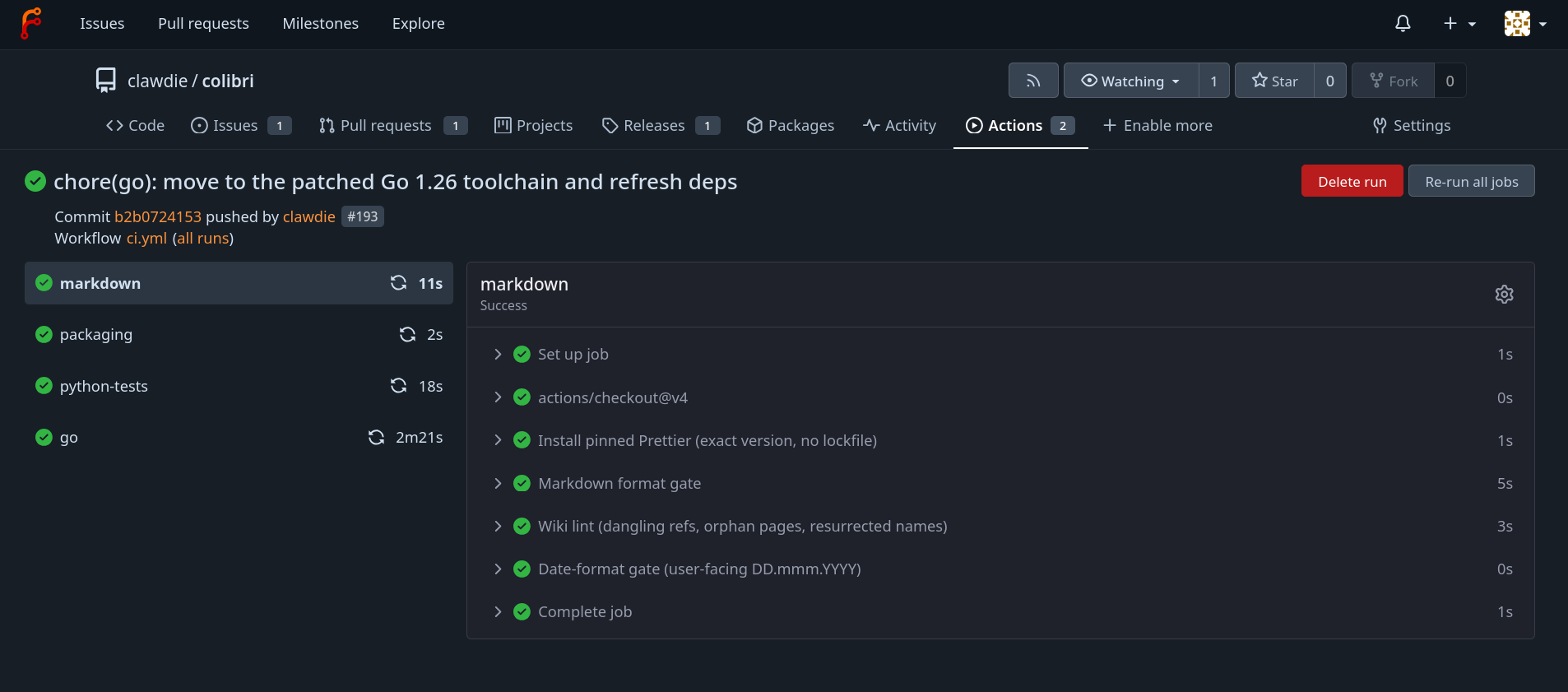
All 4 workflow jobs (markdown 11s, packaging 2s, python-tests 18s, go 2m21s) passed cleanly on Forgejo Actions:
The runner post-checkout verification confirmed clean workspace boundaries and credential scrubbing:
⭐ Run Post actions/checkout@v4
[command]/usr/bin/git version
git version 2.47.3
⚙ ***
Temporarily overriding HOME='/var/lib/forgejo-runner-linux/work/8ae16678644de785/tmp/e3464822-e906-4d2d-b348-06cdb83b0504' before making global git config changes
Adding repository directory to the temporary git global config as a safe directory
Following Step 2 sign-off, we ran three targeted Jev evaluations (agent-skills/jev-triage/jev_eval) to resolve version drift between the image builder and the 0.15 release family:
Jev verdicts: Recommended immediate implementation across all areas (clawdie-iso/build.cfg implement 0.88, packaging samples implement 0.86, Cargo provenance implement 0.61).
Bumped default in build.cfg from stale 0.13.0 to ISO_VERSION="${ISO_VERSION:-0.15.0}", aligning default builds with the FreeBSD 15 quindecim release family.
Aligned invocations and target artifact names across BUILD.md, build.sh, and docs/RELEASE-BUILD-RUNBOOK.md.
Updated packaging/freebsd/doas.conf.sample comment example to ISO_VERSION=0.15.0.
Documented the unified 0.15.0 builder default in docs/plans/RELEASE-0.15-MANIFEST-AND-IDENTITY.md.
Provenance preservation: Colibri’s Cargo.toml remains frozen at 0.13.0 as explicit component provenance, separating the product release identity (0.15.0) from the frozen legacy Rust crates.
7. Step 3 Passive Go Service Merged & Runtime Telemetry: Compiler & Vulnerability Scan Profiles on Monica
With the landing of PR #192 into main (commit 5fbaf9a), Colibri’s passive control plane service (cmd/colibri-daemon) is officially part of the core branch. Pi on Monica (Valhala, FreeBSD 15.1-RELEASE-p4, go1.26.8) verified the merged tree natively: 199 package tests passed under -race, the strict io.EOF socket refusal check passed over genuine LOCAL_PEERCRED/xucred kernel sockets, and the 36-assertion binary harness succeeded without a single failure.
During our validation sweep on Monica, we monitored live process execution in btop across two distinct operational phases: the Go compilation & verification pipeline, and the deep vulnerability reachability scan.
Compiler & Runtime Footprint: Rust vs. Go (20-Second Visual Loop)
To directly observe the operational impact of transitioning the control plane from Rust to Go, we recorded a continuous side-by-side visual transition between the respective build pipelines on Monica:
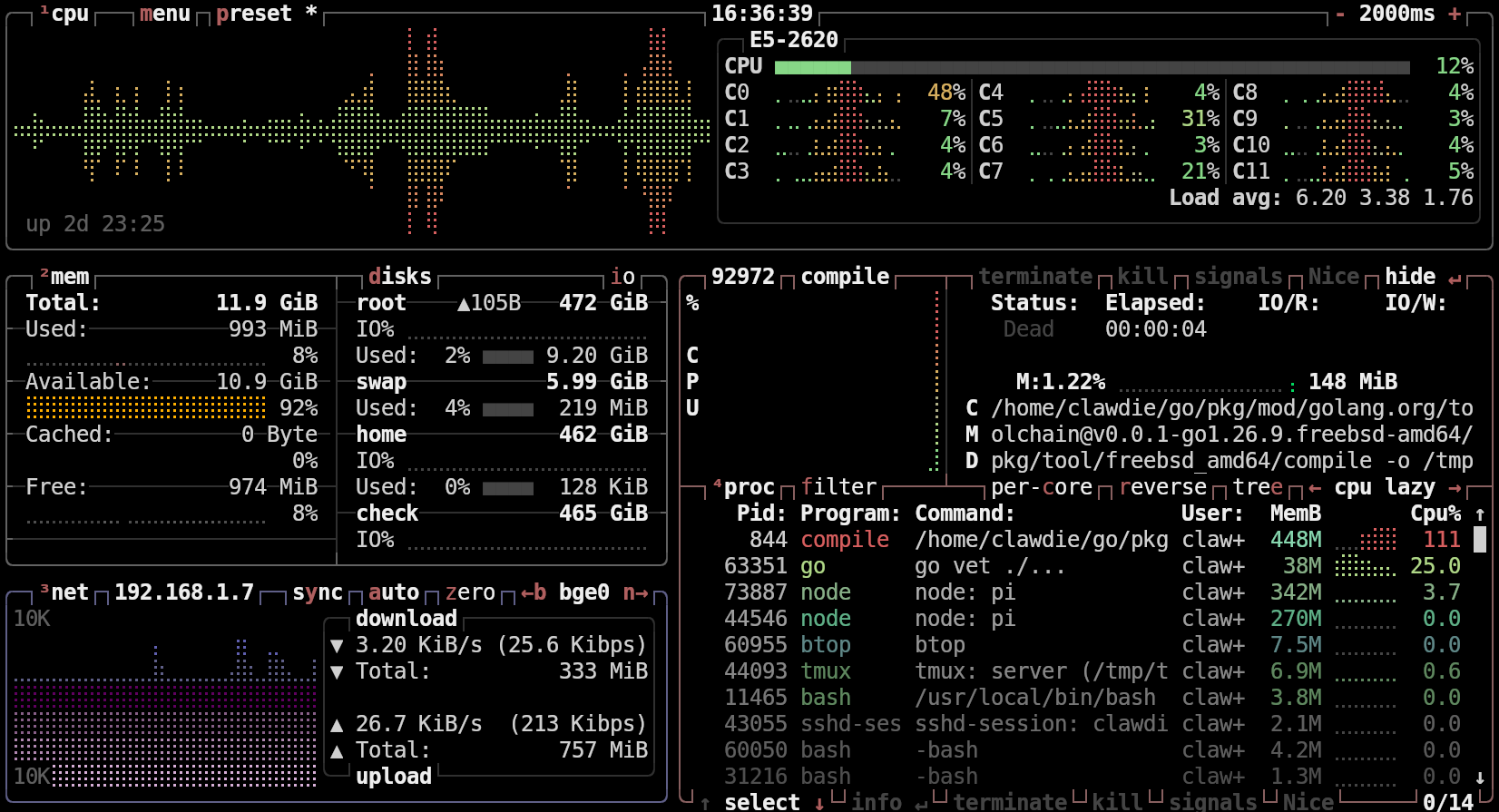
During the verification gate (go vet ./..., PID 63351), the Go toolchain spawned the native compiler backend (compile, PID 844) from the toolchain path (/home/clawdie/go/pkg/mod/golang.org/toolchain@v0.0.1-go1.26.9.freebsd-amd64/pkg/tool/freebsd_amd64/compile):
Core Dispersal Under Build Load: The compiler pegged at 111% CPU (with go vet driving it at 25%), pushing system load average to 6.20 (6.20, 3.38, 1.76).
Asymmetric Core Utilization: Load was concentrated heavily across active hardware threads: C0 peaked at 48%, C5 at 31%, and C7 at 21%, while other cores handled context switching and I/O (available memory at 10.9 GiB / 92%).
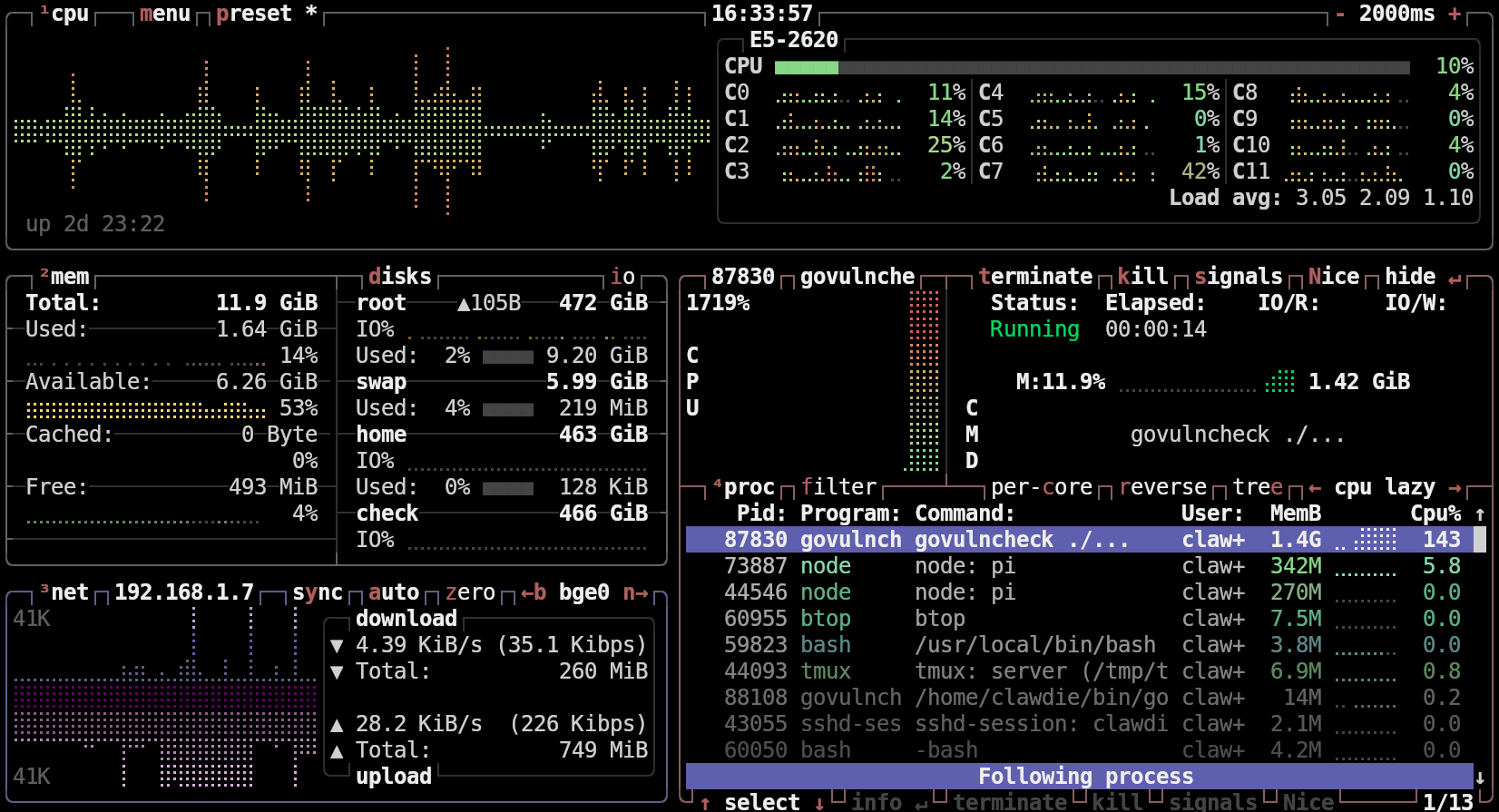
Following compilation, we ran the security audit suite with govulncheck ./... (PID 87830):
Load Dispersal: The multi-threaded scanner spiked to 143% CPU, dispersing across active cores: C7 peaked at 42%, C2 at 25%, C4 at 15%, C1 at 14%, and C0 at 11% (load average: 3.05, 2.09, 1.10).
Memory Footprint: The scanner allocated 1.42 GiB (11.9% of total memory) over 14 seconds of runtime.
Why AST/SSA Analysis is Memory-Heavy: Unlike a simple string or version check, govulncheck constructs complete abstract syntax trees and Static Single Assignment (SSA) intermediate representations for all packages in the module graph, holding call graphs in memory while resolving pointer escapes and method dispatch tables.
govulncheck is the official Go vulnerability management tool maintained by the Go security team (golang.org/x/vuln/cmd/govulncheck), backed by the authoritative Go Vulnerability Database (vuln.go.dev).
Traditional vulnerability linters (such as standard SBOM or lockfile scanners) only perform naive version matching against go.mod: if a dependency contains a CVE anywhere in its repository, they trigger an alarm—generating massive alert fatigue.
govulncheck solves this with Symbol-Level Call Graph Reachability:
Module Evaluation: Checks whether a required module has known CVEs.
Package Evaluation: Determines whether your codebase actually imports the package containing the vulnerability.
Call-Graph Reachability (The Key Innovation): Analyzes whether any execution path from your main() or exported functions can ever reach the specific vulnerable function or method. If a library has an exploit in an XML parser, but you only use its string utilities, govulncheck recognizes that the vulnerable code is unreachable and will not flag it as an active risk.
On Monica, the scan confirmed that zero third-party dependencies call vulnerable symbols, giving us an empirical, reachability-backed security baseline as Colibri transitions its control plane to Go.